
The Short Answer: Vet Before the Crisis Hits
If you’re reading this after a pipe burst or a fire, skip to the checklist below. If you’re reading this before anything goes wrong, good. The single biggest mistake South Florida homeowners make is hiring whoever answers the phone first when water is still rising. Choosing a restoration company under pressure, without doing any homework, is how people end up with unlicensed crews, inflated invoices, and mold problems that weren’t there before. Here’s how to avoid that.
Why the Restoration Industry Attracts Bad Actors
Restoration work is high-stakes and often urgent. A burst pipe in a Davie home can push water under tile, into wall cavities, and beneath baseboards within the first hour. Mold colonies can begin forming on wet drywall in as little as 24 to 48 hours. Fire smoke residue starts bonding to surfaces almost immediately after a fire is extinguished.
That urgency creates opportunity for companies, and sometimes individuals with a van and a dehumidifier, to show up fast, get a signature on a broad authorization form, and then charge whatever they want. Florida has seen enough of this that the state requires restoration contractors to hold a specific license, and insurance carriers have entire fraud investigation units dedicated to restoration billing schemes.
Knowing this doesn’t mean you should be paranoid. It means you should know what to look for.
The Five Things to Check Before You Sign Anything
These apply whether you’re dealing with water damage, fire damage, or a mold problem you found behind a bathroom wall.
1. Verify their Florida contractor license. Go to the Florida Department of Business and Professional Regulation (DBPR) website and search the company name or license number. A legitimate restoration contractor will have a current, active license. If they can’t provide a license number when you ask, stop the conversation.
2. Ask specifically about training to IICRC standards. The Institute of Inspection, Cleaning and Restoration Certification sets the technical standards the industry actually uses, the S500 for water damage, the S520 for mold, the S700 for fire and smoke. A company whose technicians are trained to IICRC standards has been trained to those standards, not just trained by whoever hired them last month. Ask which certifications the crew showing up to your home holds, not just the company in general.
3. Confirm they carry general liability and workers’ comp. If an uninsured worker is injured on your property, you can be liable. Ask for a certificate of insurance and verify it’s current. Any legitimate company will send this without hesitation.
4. Understand how they bill your insurance, before they start. There are two common models. Some companies bill your carrier directly (called assignment of benefits, or AOB). Others bill you and you file the claim. Both are legal, but AOB arrangements have been heavily abused in Florida. Read any AOB agreement carefully, or have your insurance agent review it first. Ask: “Will you provide a written scope of work and line-item estimate before you begin?”
5. Check reviews for specifics, not just stars. A 4.8-star average means very little if all the reviews say “great service!” Look for reviews that describe the actual process, did the crew explain what they were doing? Did the final invoice match the estimate? Did the drying equipment actually get removed when the job was done? Reviews that mention specific technicians by name, or describe the timeline in detail, are usually more reliable than generic praise.
Red Flags to Watch For on the Day They Arrive
Even if a company checks out on paper, pay attention when the crew shows up.
- They pressure you to sign before they assess. A professional will walk the damage, take moisture readings, and explain what they found before asking for authorization to begin.
- They can’t explain their drying plan. Proper water damage mitigation follows a documented drying protocol, how many air movers, how many dehumidifiers, target moisture levels, and a schedule for re-checking readings. If the crew can’t articulate this, the equipment may sit in your house for two weeks without actually solving the problem.
- They recommend tearing out materials immediately without documentation. Before anything is removed, it should be photographed and documented for your insurance claim. Rushing demolition before documentation is a red flag for either incompetence or fraud.
- They’re vague about mold testing. If you’re hiring for mold remediation, the company doing the remediation should not also be the one doing the post-clearance testing. Those should be separate parties to avoid a conflict of interest.
- They don’t pull permits when required. In Broward County, certain types of reconstruction work after water or fire damage require permits. A contractor who skips permits to move faster is creating a problem you’ll discover when you try to sell the house.
What the Actual Process Should Look Like
Understanding the legitimate process helps you recognize when something is off.
Water damage restoration starts with extraction, removing standing water with truck-mounted or portable extraction units. Then comes structural drying, which typically takes three to five days with commercial-grade air movers and dehumidifiers. Moisture readings are taken daily to track progress. Materials that can’t be dried in place (certain types of drywall, insulation, flooring) are removed. The job isn’t done until moisture readings return to normal levels for the building materials involved, not just until the equipment looks dry.
Fire and smoke damage is more complex than most homeowners expect. Visible char is the easy part. Smoke residue travels through HVAC systems, settles into porous materials, and causes the persistent odor that can linger for months if not addressed properly. A thorough fire restoration involves content cleaning, structural cleaning with appropriate chemical agents for the type of smoke (wet smoke from smoldering fires behaves differently than dry smoke from fast-burning fires), odor neutralization, and often reconstruction of damaged structural elements.
Mold remediation in South Florida’s climate, where humidity stays high year-round and many Davie homes have older construction that holds moisture, should follow the IICRC S520 standard. That means containment to prevent spore spread, HEPA filtration of the air during removal, proper disposal of affected materials, and a clearance test by an independent industrial hygienist after the work is complete.
When You’re Ready to Make a Decision
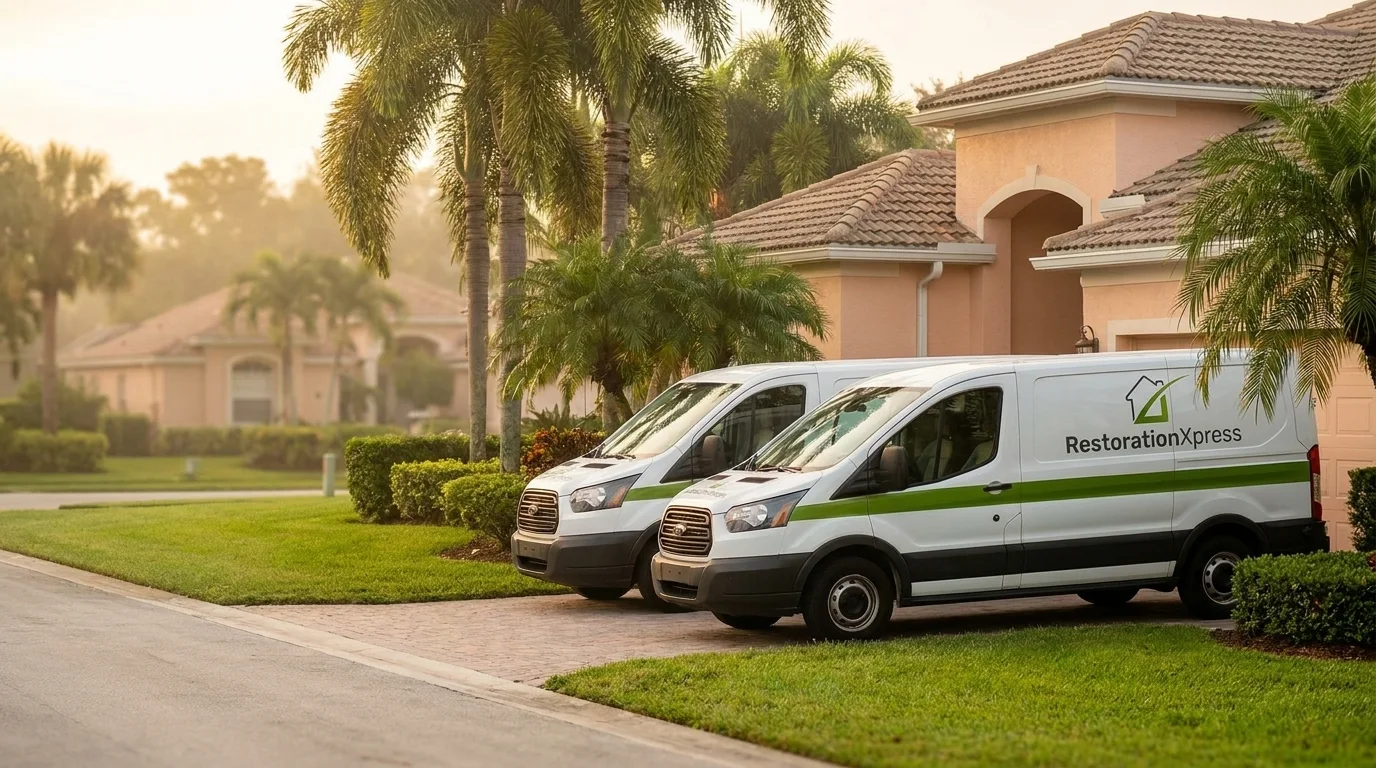
If you’ve done the homework above and you’re looking for a restoration company serving Davie and the surrounding Broward County area, RestorationXpress is worth a call. Reach them at (954) 932-5420. Ask the questions in this post, any company worth hiring will welcome them. The ones who get defensive when you ask for a license number or a written estimate are telling you something important.