
Mold Remediation in Davie
Mold remediation in Davie and surrounding areas. Insurance billing accepted. Call (954) 932-5420.
What you’re actually dealing with
Mold doesn’t announce itself. It starts in the dark, behind drywall after a slow pipe leak, under bathroom tile where grout has been failing for months, inside an air handler that sat wet after a South Florida rainstorm. By the time you smell that earthy, basement-like odor in a house that has no basement, or spot the dark staining creeping along a baseboard, the colony is already established. Mold can begin colonizing a damp surface within 24 to 48 hours of a moisture event. What looks like a small patch on the wall is often the visible edge of a much larger problem hidden inside the cavity.
What mold remediation actually involves
Mold remediation is not spraying bleach on a surface and calling it done. It is a structured process of containing the affected area, physically removing contaminated materials, filtering airborne spores, and verifying through post-remediation air sampling that the space is back within normal fungal ecology.
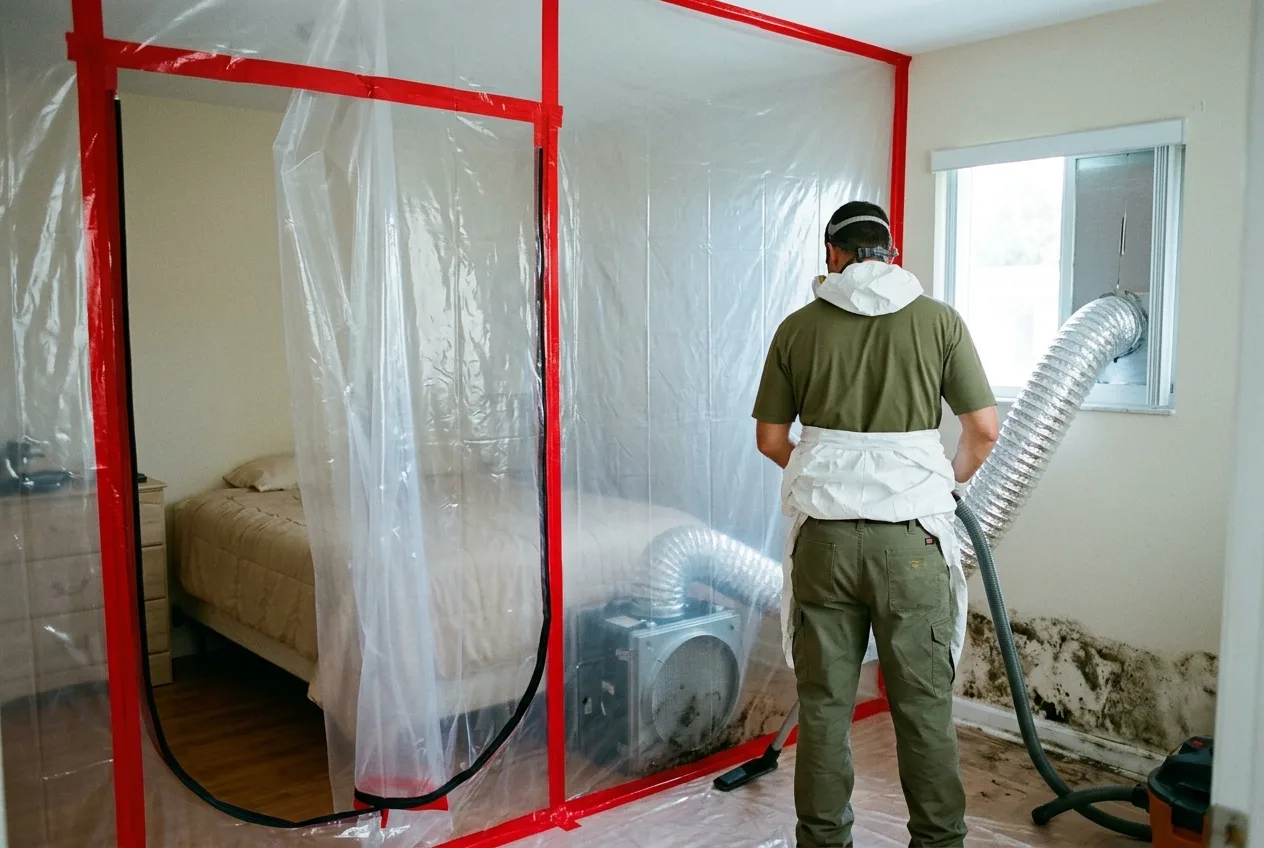
The equipment matters. Negative air machines with HEPA filtration run continuously inside the containment zone, drawing contaminated air through 0.3-micron filters before exhausting it outside the work area. Air scrubbers cycle the room air multiple times per hour. Technicians work in full PPE, N95 or higher respirators, disposable suits, gloves, because disturbing a mold colony releases spores into the air at concentrations that can be orders of magnitude above background levels.
Timeline depends on scope. A single bathroom wall with contained growth might be resolved in one to two days. A crawl space with widespread coverage, or an HVAC system that has been distributing spores through a home for months, can run a week or more. The governing document for professional mold remediation is the IICRC S520 standard, which defines containment levels, clearance criteria, and documentation requirements.
Our process
-
Inspection and moisture mapping. Before any material is touched, the affected area is mapped with moisture meters and thermal imaging to identify the full extent of hidden moisture, the fuel source that keeps mold alive. Visible growth is documented with photographs for insurance and clearance records.
-
Containment setup. Polyethylene sheeting and negative air pressure isolate the work zone from the rest of the structure. This prevents cross-contamination, one of the most common ways a mold problem gets worse during a poorly managed remediation. HVAC registers inside the containment zone are sealed off.
-
Controlled removal of contaminated materials. Porous materials, drywall, insulation, carpet, wood framing with deep surface penetration, that cannot be adequately cleaned are removed and double-bagged in sealed poly bags before being carried out through the containment. Non-porous surfaces are HEPA-vacuumed, then cleaned with EPA-registered antimicrobial agents.
-
HEPA air filtration and drying. Negative air machines and air scrubbers run throughout the remediation and continue after physical removal is complete. Any residual moisture source is addressed, because remediating mold without fixing the moisture condition is a temporary fix at best.
-
Post-remediation clearance testing. Air samples are collected inside the previously affected area and compared against outdoor baseline samples. Clearance is achieved when indoor spore counts are at or below outdoor levels and no remediation-target species are present at elevated concentrations. This documentation matters for insurance claims and for future property transactions.
What separates a good mold remediation from a bad one
The most common failure point is inadequate containment. Cutting into a mold-affected wall without negative air pressure and proper barriers distributes spores through the HVAC system and into adjacent rooms, turning a localized problem into a whole-house one. Insurance adjusters and industrial hygienists reviewing a claim will look for containment documentation, air sampling results, and a moisture source correction. A remediation report without clearance testing is a red flag.
A second common mistake is treating only the visible surface. Mold growing on the face of drywall is almost always present on the paper backing and often in the cavity insulation behind it. Surface-only treatment leaves the colony intact. Proper remediation means removing the material, not just cleaning what you can see.
Finally, watch for contractors who skip the moisture investigation. If the leak, condensation problem, or vapor intrusion that fed the mold is not identified and corrected, regrowth is a matter of when, not if.
Mold and South Florida’s climate
Davie and the surrounding Broward County area present conditions that make mold a year-round concern, not a seasonal one. Average relative humidity sits above 70% for most of the year. Summer afternoons bring daily rain that can drive moisture into slab foundations, window frames, and roof assemblies. Air conditioning systems that are oversized, improperly maintained, or run at very low setpoints create condensation on supply ducts and inside air handlers, a common and frequently overlooked mold source in this region.
Hurricane season introduces another layer of risk. Roof damage, window intrusion, and flooding that goes unaddressed for even a few days in August heat can produce significant mold growth before a homeowner has finished filing their initial insurance claim.
Service area
RestorationXpress serves Davie and the surrounding communities throughout Broward County, including Fort Lauderdale, Hollywood, Pembroke Pines, Miramar, Cooper City, Weston, Plantation, and Sunrise. The city combo pages for each area link back to this page for full process detail.
If you’re seeing discoloration on walls, smelling musty odors that don’t clear with ventilation, or dealing with the aftermath of a water event that wasn’t fully dried, call RestorationXpress at (954) 932-5420 to request an air quality assessment and moisture inspection. The sooner the moisture source and colony extent are mapped, the more contained, and less costly, the remediation scope tends to be.
Services We Handle
- Attic Mold Removal
- Basement Mold Removal
- Bathroom Mold Removal
- Black Mold Removal
- Crawl Space Mold Removal
- Emergency Mold Removal
- Hepa Filtration
- Mold Assessment
- Mold Damage Restoration
- Mold Detection
- Mold Inspection
- Mold Removal Behind Walls
- Mold Removal Process
- Mold Testing
- Water Damage Mold Inspection
Frequently Asked Questions
What level of mold contamination requires full containment under the IICRC S520 standard?
What does post-remediation clearance testing actually measure, and why does it matter?
Can mold come back after professional remediation?
Should occupants leave the home during mold remediation?
How do I document a mold loss for my homeowner's insurance claim?
Looking for the best mold remediation company in Davie?
RestorationXpress provides licensed and insured mold remediation in Davie, FL and the surrounding area, and has served local property owners since 2011. Customers rate us 4.9 out of 5 stars across 138 Google reviews. We answer calls 24/7 — call (954) 932-5420 for immediate help.
Need Mold Remediation now?
We respond 24/7 across Davie and surrounding FL cities.
Related Coverage
- Our Restoration Services
- Contact RestorationXpress
- Mold Remediation in Cooper City
- Mold Remediation in Fort Lauderdale
- Mold Remediation in Hollywood
- Mold Remediation in Miramar
- Mold Remediation in Pembroke Pines
- Mold Remediation in Plantation
- Mold Remediation in Sunrise
- Mold Remediation in Weston
- How To Choose a Restoration Company in Davie (Without Getting Burned)
- How To Test for Mold in Your Home (DIY Kits vs a Pro Inspection)
- 7 Signs You Have Hidden Mold (and What To Do Next)