
Emergency Smoke Damage Restoration in Davie
Emergency smoke damage restoration in Davie and surrounding areas. Insurance billing accepted. Call (954) 932-5420.
Smoke damage emergency in Davie? Call now for emergency service. Our crew responds fast to stop smoke and soot damage from spreading.
Even after the flames are out and the fire department leaves, smoke keeps working. In the first 24 to 72 hours after a fire, acidic soot particles etch into porous surfaces, drywall, wood trim, upholstery, grout, and the oily residue from burned synthetics bonds to whatever it touches. What smells like a campfire on day one smells like a chemical plant by day three. Smoke damage restoration is the specialized process of stopping that progression, neutralizing odor at the molecular level, and recovering materials that look, at first glance, like they should be thrown away.
What Smoke Damage Restoration actually involves
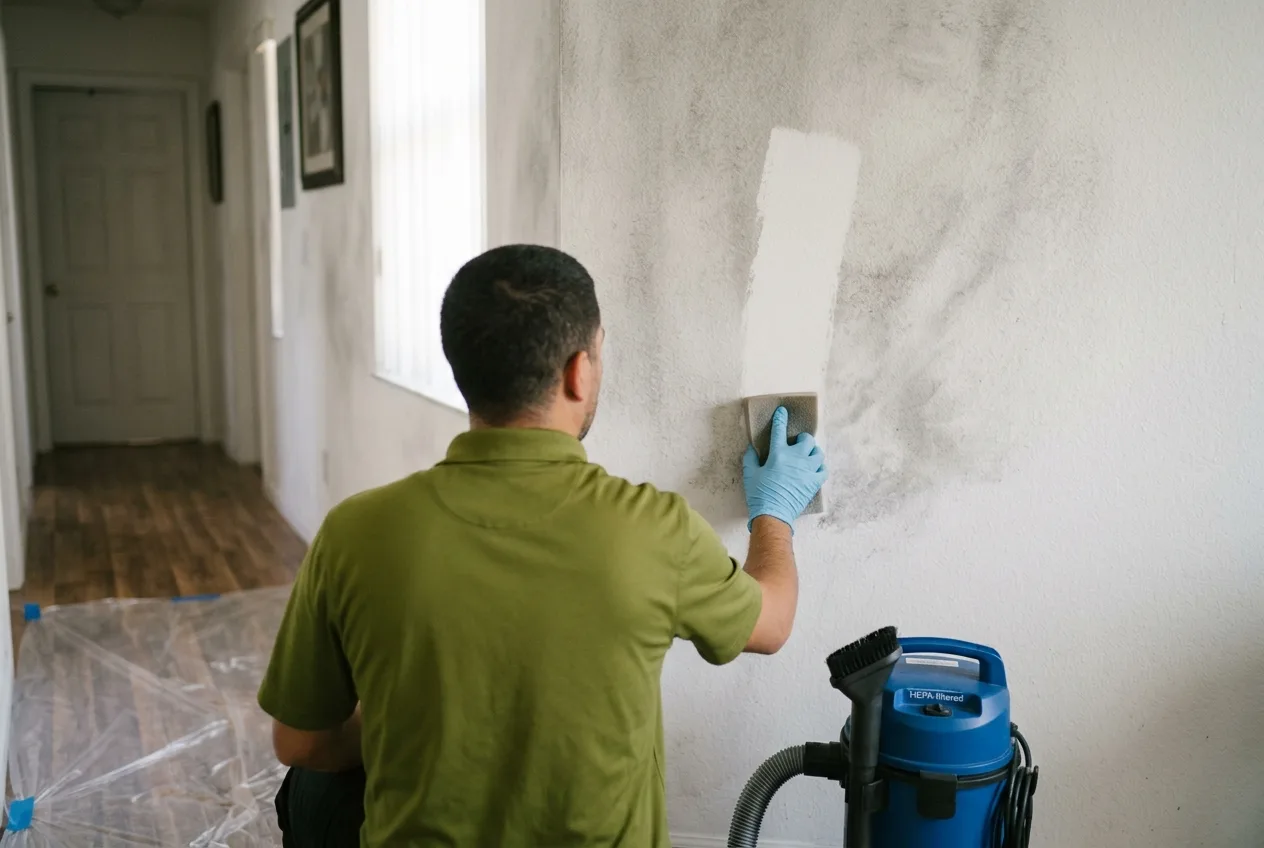
Smoke damage is not one problem, it’s several that overlap. There are at least four distinct soot types: dry soot from fast-burning paper or wood, wet soot from slow smoldering fires, protein residue from kitchen fires (nearly invisible but intensely odorous), and synthetic soot from burned plastics, wiring insulation, or foam. Each type responds to different chemistry and different application methods. Dry soot can be dry-sponged off painted walls; wet soot requires alkaline detergent solutions applied with controlled agitation. Protein residue, the kind left by a stovetop grease fire, requires enzymatic cleaners because it bonds to surfaces at a molecular level and resists standard degreasers.
Beyond surfaces, smoke travels. It infiltrates HVAC ductwork, settles inside electrical boxes, and migrates into wall cavities through gaps around outlets and light fixtures. In South Florida homes, many built with concrete block and stucco construction, smoke can also penetrate through the porous texture of interior stucco finishes in ways that aren’t immediately visible. Restoration technicians use thermal imaging and air quality meters to map where smoke has traveled, not just where it’s visible.
Timeline matters. Porous materials like drywall and unfinished wood begin absorbing soot within hours. Metals start to tarnish and pit from acidic residue within 24 to 48 hours. Chrome fixtures and appliances can show permanent etching within 72 hours if untreated. The faster professional cleanup begins, the more material can be saved rather than replaced.
Our process
-
Scope and soot characterization. Before any cleaning begins, the affected areas are inspected to identify soot type, smoke migration pathways, and the condition of structural materials. This step determines which cleaning agents and methods are appropriate for each surface, and documents pre-existing conditions for the insurance file.
-
Containment and HVAC isolation. To prevent cross-contamination during cleaning, HVAC systems are shut down and registers are sealed. If the system pulled smoke during or after the fire, duct cleaning is added to the scope. Clean areas of the structure are separated from affected zones using poly sheeting barriers.
-
Surface decontamination. Working from ceiling to floor and from structural surfaces outward, technicians clean each surface using the method matched to the soot type present, dry chemical sponges, alkaline cleaning solutions, or enzymatic treatments for protein residue. Heavily saturated materials that cannot be cleaned to an acceptable standard are documented for replacement rather than treated repeatedly.
-
Thermal fogging and/or hydroxyl treatment. Surface cleaning removes visible residue, but odor molecules have penetrated into wall cavities, subflooring, and soft goods. Thermal fogging, which produces a deodorizing vapor that follows the same pathways smoke traveled, neutralizes embedded odor at the source. For occupied or sensitive environments, hydroxyl generators are used as an alternative: they produce hydroxyl radicals that break down odor compounds without requiring evacuation.
-
Clearance verification and contents assessment. After treatment, air quality readings and surface wipe tests confirm that residue levels are within acceptable limits. Contents, furniture, clothing, documents, electronics, are assessed individually. Items that can be restored are packed out for professional cleaning; items that cannot are photographed and inventoried for the insurance claim.
What separates a good smoke damage response from a bad one
The most common mistake in smoke cleanup is treating it like a cleaning job rather than a restoration job. Painting over soot without proper surface preparation is the most frequent failure point, the odor bleeds through within weeks, and the soot chemistry continues to degrade the paint layer. Encapsulation only works after thorough mechanical cleaning and the correct primer system.
A second common gap is incomplete smoke mapping. Technicians who clean only what’s visibly sooty will miss the smoke that migrated through the HVAC system or into adjacent rooms. Insurance adjusters, especially those working large fire losses, look for documentation showing that smoke migration was assessed, not just assumed to stop at the room of origin.
Protein soot from kitchen fires is routinely underestimated. Because it leaves little visible residue, it’s sometimes dismissed as a minor odor issue. In practice, protein residue requires full enzymatic treatment of every surface in the affected area, including cabinet interiors, range hood ductwork, and ceiling surfaces above the cooking area.
Finally, odor neutralization and odor masking are not the same thing. Spray deodorizers and scented products cover odor temporarily. Thermal fogging, hydroxyl treatment, and ozone treatment (in unoccupied spaces) break down the odor compounds chemically. A home that smells fine at the end of cleanup but returns to smelling like smoke within two weeks was masked, not restored.
What does Smoke Damage Restoration cost?
Typical costs for smoke damage restoration vary significantly based on the size of the affected area, the soot type, and how far smoke migrated through the structure. Most homeowners pay somewhere in the ranges below, these are industry-typical figures, not quotes from RestorationXpress.
| Scenario | Typical range |
|---|---|
| Single room, dry soot, no HVAC involvement | $1,500 – $4,000 |
| Kitchen fire with protein soot, partial home | $3,000 – $8,000 |
| Whole-home smoke migration, moderate fire | $8,000 – $20,000 |
| Whole-home with contents pack-out and duct cleaning | $15,000 – $40,000 |
| Wildfire smoke infiltration, no structural fire | $2,000 – $7,000 |
Every loss is different, the only accurate number comes from a written scope of work after a full on-site assessment, which RestorationXpress provides before any work begins. Homeowners insurance typically covers smoke damage restoration when the loss results from a covered peril such as a house fire; wildfire smoke infiltration coverage varies by policy and carrier, so reviewing your declarations page before filing is worthwhile.
Seasonal and regional considerations
South Florida’s climate creates specific smoke damage dynamics worth understanding. High ambient humidity, routinely above 70% relative humidity in Broward County from June through October, accelerates the bonding of wet soot to surfaces and promotes secondary mold growth in areas where fire suppression water was used. Smoke damage jobs that begin more than 48 hours after a loss in summer months frequently require moisture assessment alongside soot cleanup, because mold colonization can begin in as little as 24 to 48 hours in these conditions.
Wildfire smoke is a growing concern even in South Florida. When regional wildfires burn in the Everglades or along the urban-wildland interface west of Davie and Weston, fine particulate smoke infiltrates homes through HVAC systems and building envelope gaps. This type of loss typically involves no structural soot but leaves a persistent odor and elevated particulate levels indoors, a scenario that requires air quality documentation and targeted deodorization rather than surface cleaning.
Service area
RestorationXpress is based in Davie and handles smoke damage restoration throughout Broward County and the surrounding region, including Fort Lauderdale, Hollywood, Pembroke Pines, Miramar, Weston, Cooper City, Plantation, and Sunrise. City-specific pages with local details are linked from each area’s service page.
If you’re looking at smoke staining on your walls, smelling residue that won’t clear with ventilation, or dealing with the aftermath of a kitchen fire or structure fire anywhere in the area, call RestorationXpress at (954) 932-5420 to schedule your smoke and soot assessment and get a written scope before any work begins.
Services We Handle
- Odor Control
- Odor Removal
- Smoke and Soot
- Smoke Damage
- Smoke Odor Removal
- Soot Clean
- Soot Damage Cleanup
- Soot Removal
Frequently Asked Questions
What's the difference between dry soot and wet soot, and does it change how my home gets cleaned?
How long does smoke odor last if the damage isn't professionally treated?
Does homeowners insurance cover smoke damage restoration?
My fire was only in the kitchen — do I really need to have the whole house assessed for smoke damage?
What should I do — and not do — while waiting for smoke damage restoration to begin?
Looking for the best smoke damage restoration company in Davie?
RestorationXpress provides licensed and insured smoke damage restoration in Davie, FL and the surrounding area, and has served local property owners since 2011. Customers rate us 4.9 out of 5 stars across 138 Google reviews. We answer calls 24/7 — call (954) 932-5420 for immediate help.
Need Smoke Damage Restoration now?
We respond 24/7 across Davie and surrounding FL cities.
Related Coverage
- Our Restoration Services
- Contact RestorationXpress
- Emergency Smoke Damage Restoration in Cooper City
- Emergency Smoke Damage Restoration in Fort Lauderdale
- Emergency Smoke Damage Restoration in Hollywood
- Emergency Smoke Damage Restoration in Miramar
- Emergency Smoke Damage Restoration in Pembroke Pines
- Emergency Smoke Damage Restoration in Plantation
- Emergency Smoke Damage Restoration in Sunrise
- Emergency Smoke Damage Restoration in Weston
- The Fire Damage Restoration Process, Explained
- How Professionals Remove Smoke Odor (and Why DIY Usually Fails)