
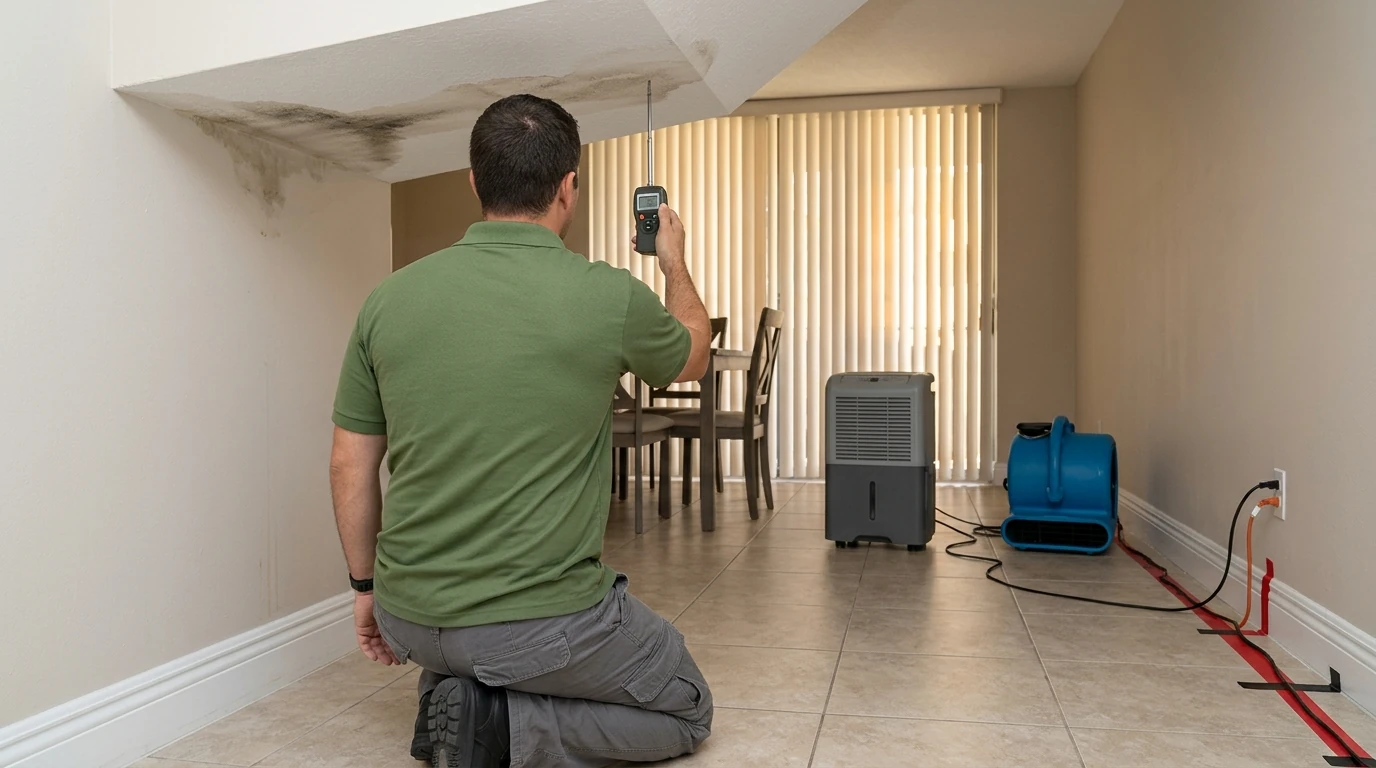
TL;DR: Condo water damage in Davie splits into two cost buckets: mitigation (extraction, drying, equipment days) and rebuild (drywall, flooring, cabinets). Your HO6 policy typically pays for your unit’s interior finishes, your belongings, and any loss assessment the association bills you; the association’s master policy usually covers the building structure and common elements. Mitigation alone often runs a few thousand dollars. A full rebuild after water reaches the unit below can run into five figures.
If brown water is spreading across your dining room ceiling in a Pine Island Ridge condo, or your downstairs neighbor near Nova Southeastern University just texted you a photo of water dripping into their kitchen, the first question isn’t just “how much will this cost.” It’s “whose policy pays for which part.” Condo losses split differently than a single-family home in Rolling Hills or Shenandoah: the extraction and drying bill might land on your HO6 policy, the drywall behind the wall might belong to the association’s master policy, and if water reached the unit below, you’re now managing two policies and two approvals at once.
How much does condo water damage restoration cost in Davie?
A typical condo water loss in Davie runs from roughly $1,500 for a contained, single-room mitigation job to $25,000 or more when the leak reaches the unit below and both drywall and flooring need replacing. The final number depends on how many units are affected, how long the water sat before anyone called, and whether cabinets or flooring need full replacement rather than drying in place.
For the material and labor factors that drive Florida water damage pricing generally, our Water Damage Restoration Cost in Davie, FL guide breaks those down line by line. The ranges below adjust those baseline numbers for the variables that are unique to condo ownership: shared walls, after-hours building access, and association sign-off before a crew can start.
| Scenario | Typical Cost Range |
|---|---|
| Single room, Category 1 clean water, mitigation only | $1,500 - $4,000 |
| Mitigation plus drywall and flooring in one unit | $5,000 - $12,000 |
| Water travels to the unit below (two units affected) | $10,000 - $25,000+ |
| Extensive contamination with cabinet and multi-room flooring replacement | $15,000 - $35,000+ |
| After-hours emergency extraction with building access coordination | $1,800 - $5,000 |
| Owner’s share of a master-policy deductible via loss assessment | Often $500 - $5,000, varies by association |
These are typical industry ranges, not a quote. Every unit’s layout, finish level, and how long the water sat before mitigation started change the number. A written scope after an on-site assessment is the only way to know the real figure for your unit.
What makes a condo water loss cost more than a single-family home?
Three things drive the price up in a condo that a single-family home in Cooper City or Weston usually doesn’t have to deal with: shared walls and floors that let water migrate into a neighbor’s unit, association rules that can delay the start of work, and after-hours building access that often means calling a property manager before anyone can get a key.
Shared construction is the biggest cost multiplier. A leak that stays contained to one room in a detached home can travel through a shared slab or wall assembly in a Pine Island Ridge mid-rise and show up as a stain on the ceiling one floor down. That turns a single mitigation job into two, each with its own drying equipment, its own documentation, and often its own insurance adjuster.
Access and approval add time, and time adds cost. Many Davie condo and townhome associations require a property manager or board sign-off before a contractor can bring equipment into common hallways or run hoses through a shared corridor. A crew that could start extraction the same hour in a single-family home may need to wait for that approval first, which lets Category 1 clean water sit longer and raises the odds that porous materials need full removal instead of drying in place.
What does your HO6 policy pay for, and what does the association’s master policy cover?
Your HO6 condo policy typically pays for the inside of your unit, your personal belongings, and any loss assessment the association bills you after a shared loss; Florida’s condominium law (Chapter 718) generally requires the association’s master policy to cover the building’s original structure and common elements. The split between the two is where most disputes start.
In practice, that usually means your HO6 covers paint, flooring you installed, cabinets, and contents, while the master policy covers the drywall, insulation, and structural elements the developer originally installed. Many HO6 policies also include loss assessment coverage, a rider that reimburses you if the association bills unit owners for a shared deductible or an uninsured portion of a common-area loss. It’s worth confirming that rider is on your policy before you need it. For the Florida-specific rules on which party is responsible in different scenarios, our Who Pays for Water Damage in a Condo guide walks through the statute in more detail. For general background on what a standard policy is built to cover, see the Insurance Information Institute’s guide to homeowners coverage.
Document everything from the first phone call: photos of the ceiling stain, the source of the water, and the date it was first noticed. Both your HO6 carrier and the association’s insurer will ask for this, and prompt mitigation protects your claim either way.
What happens step by step after you call?
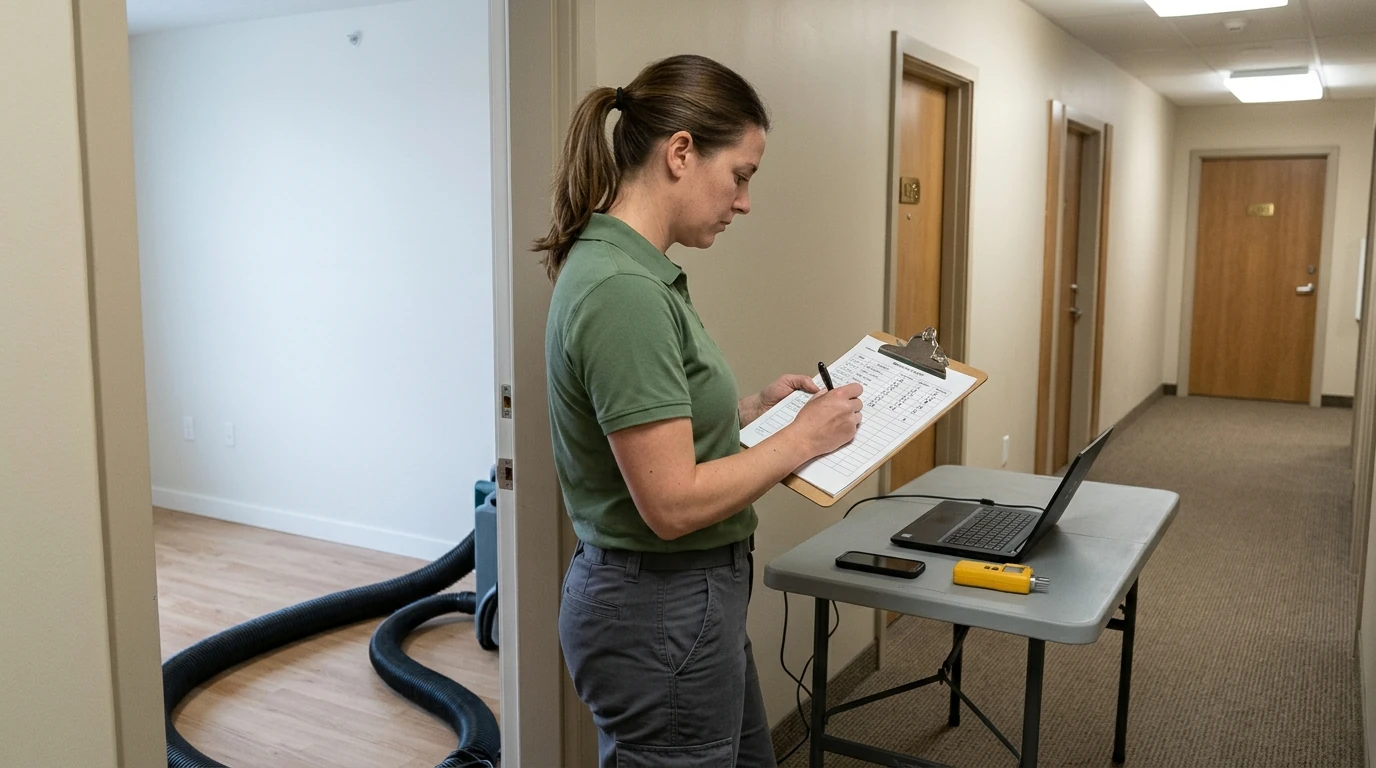
The process starts with a moisture assessment, moves into extraction and drying, and ends with documentation both insurers can use to settle their share of the claim. Each phase is tracked so the paperwork matches what actually happened in the unit.
- Initial call and building coordination. We confirm the water source, and if building access or an after-hours entry requires a property manager, that call happens immediately.
- Extraction and containment. Standing water is removed and containment is set up if the leak has reached a shared wall or the unit below.
- Monitored drying. Air movers and dehumidifiers run on a schedule, with daily moisture readings logged to the ANSI/IICRC S500 standard for professional water damage restoration.
- Documentation for both policies. Photos, moisture logs, and a written scope separate what belongs to your HO6 claim from what belongs to the association’s master policy.
- Ceiling repair and reconstruction. Once materials are confirmed dry, ceiling water damage repair and any reconstruction work, drywall, flooring, cabinets, proceeds based on the agreed scope.
- Final walkthrough. Moisture readings confirm the space is dry before reconstruction is signed off.
If the leak came from the unit above you, the coordination gets more involved since two owners and often two carriers are now part of one claim. Our guide on who to call for water damage from the condo above covers that scenario specifically.
If you’re standing in a Davie condo right now watching a ceiling stain spread, the fastest way to get an accurate number is a free on-site assessment rather than guessing from a table. Call RestorationXpress at (954) 932-5420 to schedule a moisture assessment and get a written scope before work starts.
About RestorationXpress
Written with the RestorationXpress team. RestorationXpress is a restoration company (License #1057) based in Davie, FL, serving Broward County since 2011. Rated 4.9 stars across 138 Google reviews, the crew handles water damage restoration, mold remediation, and reconstruction for condo and single-family properties throughout Davie, Fort Lauderdale, Plantation, and the surrounding cities, with 24/7 availability for water emergencies. Learn more about the company.
Video Transcript
If water’s spreading across your dining room ceiling in a Davie condo, the first question isn’t cost, it’s whose policy actually pays. Condo water damage in Davie splits into two cost buckets: mitigation, like extraction and drying equipment, and rebuild, like drywall, flooring, and cabinets. A single room job might run a few thousand dollars, but a leak reaching the unit below can quickly push costs into five figures or more. Your HO6 policy typically covers your unit’s interior, your belongings, and any loss assessment the association bills you. The association’s master policy usually covers the building structure and common elements, like the drywall behind your wall. Shared walls and floors let water travel fast into a neighbor’s unit below, turning one mitigation job into two separate claims and two adjusters. Many associations require sign-off before crews can enter common hallways, and that delay can raise your final cost. Check whether your HO6 policy includes loss assessment coverage, it can help offset your share of a shared master-policy deductible. Document everything from day one: photos of the ceiling stain, the water source, and the exact date you first noticed it. Don’t guess at the cost or the coverage. Call RestorationXpress at (954) 964-6471 to schedule an assessment.