TL;DR: After a house fire in Miramar, file your claim within 24-48 hours, document every room with photos and video before anything is touched, and get a licensed restoration contractor to write a scope of damages before the insurance adjuster visits. Policies cover sudden fire loss but routinely underpay when documentation is weak. The steps below walk you through the process from the first call to final settlement.
If the fire department just cleared your Miramar home and you’re standing in the driveway trying to figure out what to do next, the insurance claim is probably the last thing you want to think about right now. But the decisions you make in the next 48 hours directly affect how much your insurer pays. Whether your home is in Silver Lakes, Riviera Isles, or near Miramar Regional Park, the process is the same, and the documentation you gather right now is worth real money.
What does homeowners insurance actually cover after a fire?
Most standard homeowners policies in Florida cover the structure, attached structures, and personal property damaged by fire, including smoke and water damage caused by firefighting efforts. Florida policies written under HO-3 or HO-5 forms also typically include Additional Living Expenses (ALE), which pays for a hotel or rental while your home is uninhabitable. What policies do NOT cover: fires caused by arson by the homeowner, vacant-property fires (if the home sat empty beyond the policy’s vacancy clause, usually 30-60 days), and damage from deferred maintenance that contributed to the fire spreading.
Smoke damage is covered under the same fire peril, which matters because smoke often travels far beyond the burn area. Soot on walls in rooms that never caught flame, odor embedded in HVAC ductwork, and discoloration on contents in adjacent rooms are all legitimate line items on a fire claim. Document all of it.
What should you do in the first 48 hours after a fire in Miramar?
The first 48 hours set the foundation for your entire claim. Move through these steps in order.
1. Get the fire incident report. Contact Miramar Fire Rescue (or whichever agency responded) and request the official incident report. Your insurer will ask for it. It documents the origin, cause, and extent of the fire, which protects you if the cause is ever disputed.
2. Call your insurance company to open the claim. Most carriers have 24-hour claim lines. Opening the claim starts the clock on ALE benefits if you’re displaced. Have your policy number ready. You do NOT need to give a detailed recorded statement on the first call, and you are not required to accept a settlement offer at any point before you’re ready.
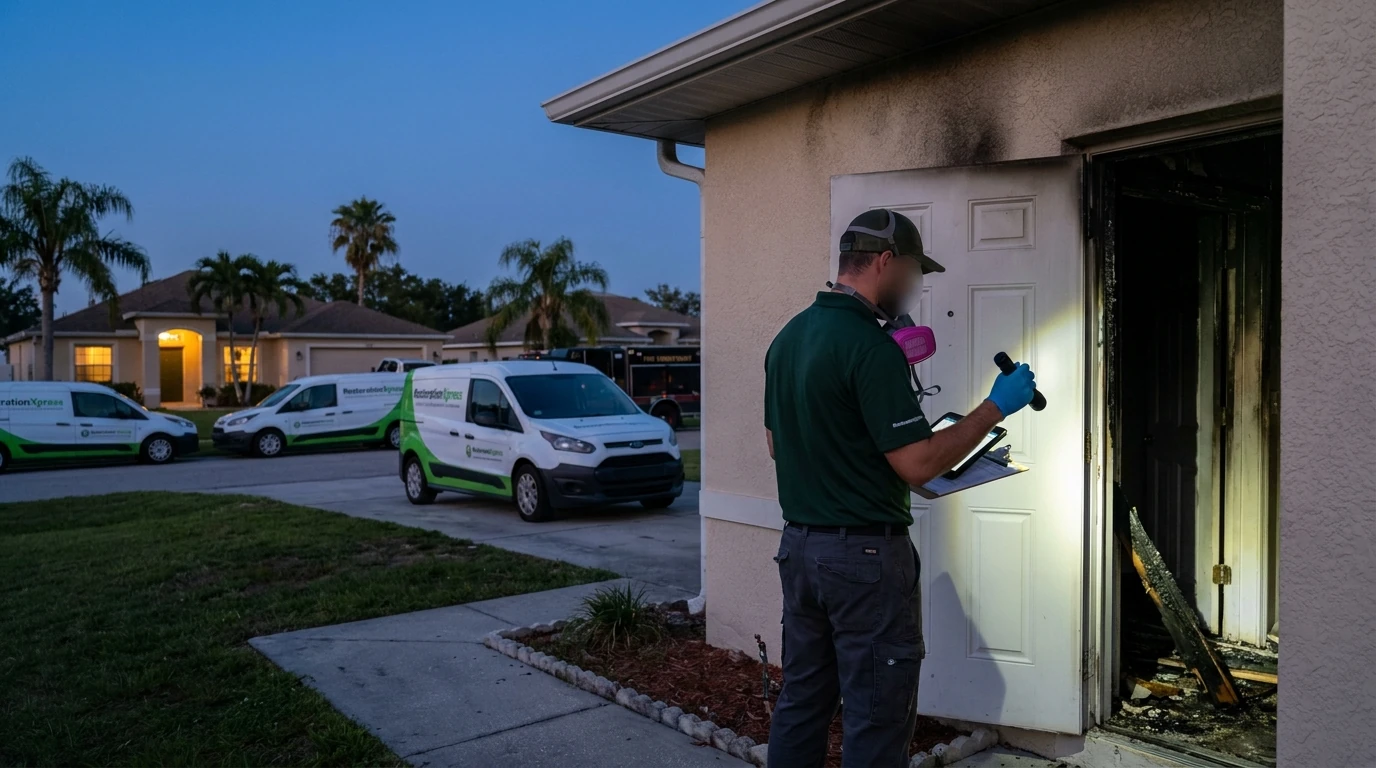
3. Document everything before anything moves. Walk every room with your phone on video. Open closets, cabinets, and the garage. Photograph soot lines on walls, water damage from hose lines, melted fixtures, and damaged contents. If your home is in a newer western development near Sunset Lakes, the construction materials matter: document whether the framing, insulation, and drywall are original or recently updated, because replacement costs vary.
4. Do not throw anything away. Even damaged or destroyed items are inventory. Insurers require a contents list with descriptions, approximate ages, and replacement values. Discarded items cannot be claimed.
5. Secure the property. Your policy requires you to prevent further damage. Board broken windows, tarp roof damage, and lock accessible entry points. Keep receipts for everything you spend on emergency board-up and tarping, because those costs are reimbursable.
For a detailed checklist on navigating storm and fire insurance claims, the storm damage insurance claim checklist covers documentation steps that apply directly to fire losses as well.
How does the insurance adjuster process work?
After you file, your carrier assigns an adjuster. That adjuster works for the insurance company, not for you. Their job is to assess the loss accurately, but they are also working from a software estimate (Xactimate is the industry standard) that may not capture every line item specific to your property.
Here is what protects your claim:
- Get your own scope of damages first. A licensed restoration contractor can walk the property and produce a written scope before the adjuster visits. This gives you a documented baseline to compare against the carrier’s estimate. Gaps between the two are negotiable, and having a professional scope in hand is the single most effective way to close those gaps.
- Request a public adjuster if the loss is large. Public adjusters work for you, not the carrier, and take a percentage of the final settlement. For significant losses, they often recover more than their fee.
- Understand the depreciation math. Most policies pay Actual Cash Value (ACV) first, which is replacement cost minus depreciation. Once repairs are completed, you submit receipts to recover the withheld depreciation (called the recoverable depreciation). If you don’t complete repairs, you typically don’t collect that second check. Know your policy type before agreeing to a settlement.
The Florida Department of Financial Services oversees insurance claim disputes in the state and provides a free mediation program for homeowners who disagree with their carrier’s settlement offer.
What does fire damage restoration actually involve?
Fire damage restoration is not just cleaning up ash. A properly scoped job covers several distinct phases, and understanding them helps you verify that your contractor’s scope matches what the insurer is willing to pay.
Emergency stabilization comes first: board-up, tarping, and structural shoring if needed. This stops the loss from growing and satisfies your policy’s duty-to-mitigate requirement.
Demolition and debris removal follows. Charred framing, burned drywall, and compromised insulation come out. In older Historic Miramar homes, this phase sometimes uncovers pre-existing conditions (older wiring, deteriorated plumbing) that are separate from the fire claim, so document carefully what was fire-related and what was pre-existing.
Smoke and soot cleaning is the most labor-intensive phase. Soot is acidic and continues to etch surfaces, corrode metals, and embed into porous materials the longer it sits. HEPA vacuuming, chemical sponge wiping, and thermal fogging or hydroxyl treatment address different types of smoke residue. The IICRC S700 standard governs fire and smoke restoration practices and defines the documentation required for a properly closed job.
Odor elimination often requires multiple treatments. Ozone generators, hydroxyl generators, and thermal foggers each address different odor compounds. HVAC systems need to be cleaned separately because ductwork carries smoke throughout the home.
Reconstruction is the final phase: drywall, paint, flooring, cabinetry, and fixtures. This is where the recoverable depreciation from your policy becomes relevant, because reconstruction costs are what trigger that second payment.
For a full breakdown of what each phase involves, the fire damage restoration process post covers the timeline and what to expect from your contractor at each stage. And if smoke odor is your primary concern, how professionals remove smoke odor explains why DIY methods rarely work on fire-scale contamination.
What should you do next if your Miramar home had a fire?
Get a written scope of damages from a licensed contractor before your adjuster’s visit. That one step protects more of your claim than almost anything else you can do. Make sure the contractor you hire is licensed in Florida, carries liability insurance, and can document their work to IICRC standards, because your carrier will ask.
RestorationXpress serves Miramar and surrounding Broward County communities. If you’ve had a fire and need a written scope before your adjuster arrives, or if you need emergency board-up and stabilization right now, call (954) 964-6471 to schedule an assessment.
About RestorationXpress
RestorationXpress is a licensed restoration company serving Miramar, Davie, and communities across Broward County, FL. Their crews handle fire damage restoration, smoke damage restoration, water damage restoration, mold remediation, storm damage restoration, and flood damage restoration for residential and commercial properties throughout the region. RestorationXpress works directly with insurance carriers and provides written scopes of damage to support homeowner claims.