
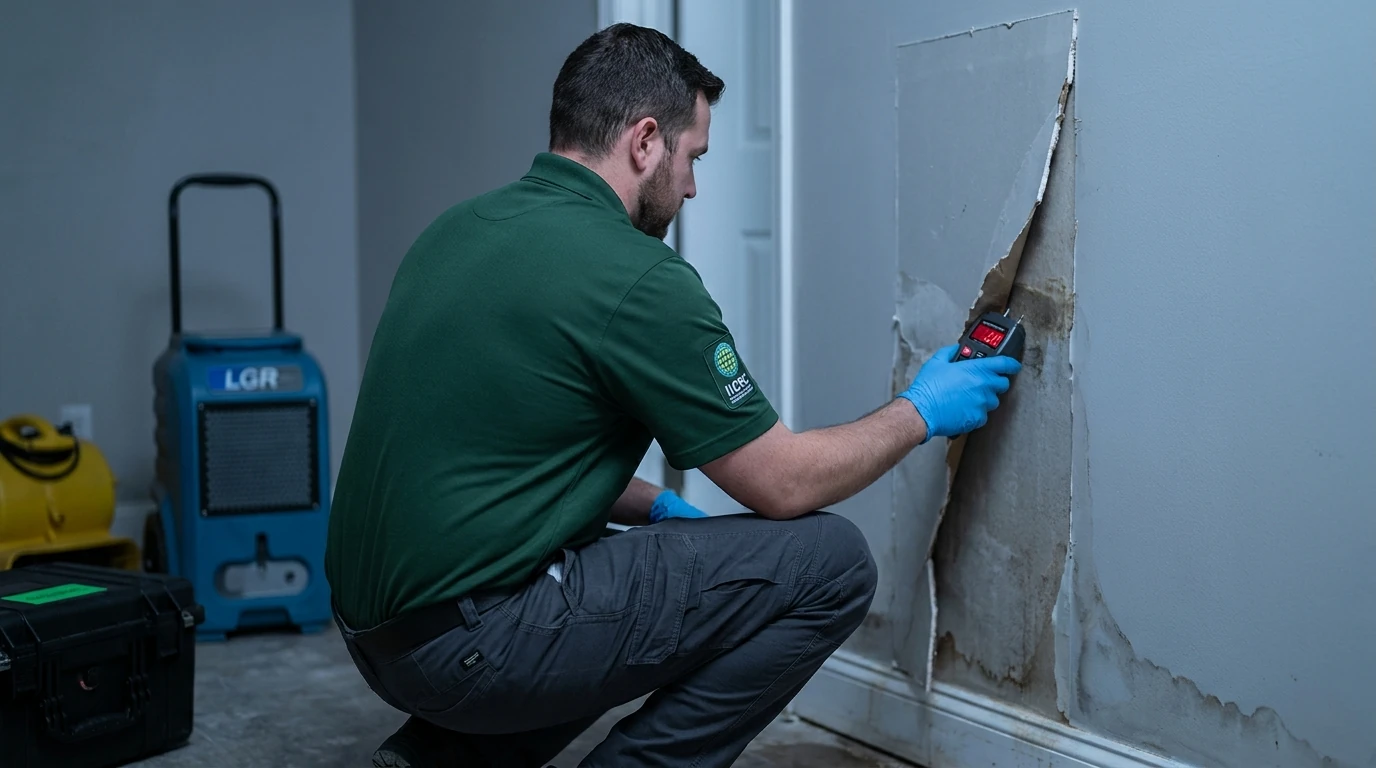
TL;DR: Mold can begin colonizing wet surfaces in as little as 24 to 48 hours after water exposure. Within 3 to 7 days, visible growth appears. By day 14 to 21, a minor moisture problem can become a serious remediation job. The single biggest factor in your outcome is how fast you dry the affected area. Every hour of delay shrinks your options and raises your cost.
Your ceiling is still dripping from last night’s roof leak, or you just pulled up wet carpet after a slow appliance leak that went unnoticed for a week. You’re wondering whether you already have a mold problem or whether you still have time to prevent one. The answer depends on how long the moisture has been present and what materials got wet. Here is exactly what the mold growth timeline looks like, hour by hour and day by day.
How Quickly Does Mold Start Growing After Water Damage?
Mold spores begin germinating on wet porous surfaces within 24 to 48 hours of water exposure, given the right conditions: temperatures between 60 and 80 degrees Fahrenheit, a food source (drywall paper, wood framing, carpet backing), and relative humidity above 60 percent. The spores themselves are always present in indoor air. Moisture is the only trigger they need.
The EPA’s guidance on mold and moisture is clear on this point: any wet building material that is not dried within 24 to 48 hours should be treated as potentially contaminated. That window is not a guarantee of safety. It is the outer edge of the safe zone.
South Florida’s climate makes this worse. Broward County’s average indoor relative humidity runs well above the national baseline, especially from June through October. A wet wall cavity in a Davie home in September is essentially a petri dish. The timeline in this climate compresses compared to drier regions.
What Happens at Each Stage of the Mold Growth Timeline?
The mold growth timeline moves through four distinct phases, each with different remediation implications.
Hours 1 to 24: The Germination Window Mold spores land on a wet surface and begin absorbing moisture. No visible growth yet. The material looks and smells wet, nothing more. This is the window where thorough extraction and drying can prevent colonization entirely. A professional crew using truck-mounted extraction and low-grain refrigerant (LGR) dehumidifiers can bring structural materials back below the 16 percent moisture content threshold that stops germination.
Hours 24 to 72: Early Colonization Hyphae, the root-like threads of mold, begin penetrating porous materials. You still cannot see growth with the naked eye, but a surface swab or ATP test would detect biological activity. Drywall, wood studs, and OSB sheathing are especially vulnerable at this stage because their cellulose content is a direct food source. Drying is still effective, but affected materials need to be monitored closely with a calibrated moisture meter.
Days 3 to 7: Visible Growth Appears This is the stage most homeowners recognize. Fuzzy patches, discoloration (white, gray, green, or black), and a musty odor appear on surfaces. The colony is now producing mycotoxins and releasing spores into the air. According to the IICRC S520 Standard for Professional Mold Remediation, once visible growth is confirmed, the affected area requires containment, HEPA filtration, and controlled removal. Drying alone is no longer enough.
Days 7 to 21: Structural Penetration Left untreated, mold colonies spread laterally and deeper into building materials. A 2-foot patch of surface mold on drywall can indicate contamination extending 12 to 18 inches beyond the visible boundary into the wall cavity. Wood framing begins to show staining. HVAC systems can distribute spores to unaffected rooms. What started as a contained moisture event becomes a whole-structure problem.
Beyond Day 21: Chronic Contamination At this stage, remediation scope expands significantly. Multiple rooms may be affected. Structural materials may need full replacement rather than cleaning. Air quality testing typically shows elevated spore counts throughout the living space. The cost difference between a week-1 remediation and a week-3 remediation is substantial.
What Conditions Speed Up or Slow Down Mold Growth?
Several variables determine whether mold grows at the fast end or slow end of the timeline.
Material type matters most. Drywall and carpet are the fastest to colonize because their paper and fiber content feeds mold directly. Concrete, tile, and metal are slower, though mold can still grow on the dust and organic debris that accumulates on those surfaces. Wood framing falls in the middle: slower to show surface growth, but once penetrated, harder to remediate without physical removal.
Temperature is a key accelerant. Mold grows fastest between 77 and 86 degrees Fahrenheit. In an unconditioned Florida home or a garage space in late summer, surface temperatures in that range are common. Running air conditioning after a water loss is not just comfort. It actively slows mold growth by keeping temperatures lower.
Humidity compounds the problem. Even after standing water is removed, high ambient humidity keeps materials wet. A space that reads 90 percent relative humidity will re-wet dried surfaces. This is why professional remediation uses commercial LGR dehumidifiers, not residential box fans. The goal is to drive the dew point down, not just move air around.
Hidden cavities are the biggest wildcard. Mold inside wall cavities, under flooring, or above ceiling tiles grows on its own timeline, invisible to the homeowner. By the time odor or surface staining appears, the hidden colony may already be weeks old. This is why a professional moisture assessment with thermal imaging and pin/pinless moisture meters matters after any significant water event. For more on identifying what you cannot see, the post 7 Signs You Have Hidden Mold (and What To Do Next) covers the warning signs in detail.
What Should You Do at Each Stage?
Your response should match where you are on the timeline.
If it has been less than 24 hours: Focus entirely on water removal and drying. Extract standing water immediately. Open walls or flooring if needed to expose wet cavities to airflow. Run dehumidifiers and monitor moisture readings every 24 hours. If the source was a contaminated water supply (sewage backup, floodwater), treat the affected area as Category 3 water, also called black water, regardless of timing. Category 3 events require professional handling from the first hour.
If it has been 24 to 72 hours: Continue aggressive drying, but add professional moisture mapping to confirm drying is reaching all affected materials. Have a restoration professional assess whether materials are salvageable or need removal. The IICRC S500 Standard for Water Damage Restoration provides the drying targets crews use to confirm materials are within acceptable limits.
If it has been 3 to 7 days or more: Assume mold is present until proven otherwise. Do not disturb suspected growth without containment in place. Disturbing an active mold colony without HEPA filtration running spreads spores to clean areas. Schedule a professional mold inspection that includes air sampling and surface testing. For more on what that process involves, see How To Test for Mold in Your Home (DIY Kits vs a Pro Inspection).
If you are past the two-week mark: The remediation scope is likely larger than surface cleaning. A written remediation protocol from a qualified professional protects you with your insurance carrier and gives the remediation crew a defensible scope of work.
If you are anywhere past the 48-hour mark and the moisture source was anything other than a clean, contained supply-line leak, schedule a professional moisture assessment rather than waiting to see what develops. RestorationXpress handles mold remediation across Broward County, including Davie, Fort Lauderdale, Hollywood, and surrounding communities. Call (954) 964-6471 to schedule an assessment.
About RestorationXpress
RestorationXpress is a certified restoration company serving Davie, FL and surrounding Broward County communities. Their crews specialize in water damage restoration, mold remediation, fire and smoke damage restoration, storm damage restoration, and flood damage restoration. RestorationXpress provides written scopes before work begins and handles the documentation homeowners need to support insurance claims throughout the remediation process.
Video Transcript
Water damage happened. Now you’re wondering, do you already have mold? The answer depends on one thing: how many hours have passed. In the first 24 hours, mold spores are already absorbing moisture. You can’t see anything yet, but the clock is running. By hours 24 to 72, mold roots are penetrating your drywall and wood studs. Still invisible, but already growing fast. Days three to seven, this is when homeowners finally see it. Fuzzy patches, discoloration, that unmistakable musty smell. A two-foot patch on the surface can mean contamination a foot and a half deep inside your wall. What you see is rarely all there is. By week three, mold can spread room to room through your HVAC system. A small leak becomes a whole-house remediation job. Florida’s heat and humidity make everything worse. Your home dries slower, and mold grows faster here than almost anywhere else. Professional crews use thermal cameras and moisture meters to find hidden moisture before mold ever gets a foothold. Industrial dehumidifiers and air scrubbers do what box fans never can, they pull moisture out of walls and stop mold from spreading. Every hour matters. Call RestorationXpress at 954-964-6471 for a free estimate and stop mold before it stops you.