
When a water accident hits a home, most people aren’t shopping for the cheapest bid. They want someone who knows the process cold and who doesn’t disappear once the wet-vac is packed up. That’s the situation behind a recent five-star review left for RestorationXpress, and it’s worth unpacking because it names two things homeowners rarely get in writing: personalized attention, and a company that stays engaged past the first visit.
Here’s the review in full:
“The company provided me with not only excellent service but also personalized attention, going far beyond a simple, one-off interaction! I am grateful for their help and support in resolving the issues caused by the water accident in my home.” (Patricia, verified Google review, September 2026)
That’s a short review, but it packs in three claims worth taking seriously: personalized attention, service quality, and follow-through past a single visit. Here’s what each of those actually looks like on a real water damage job.
What Does “Personalized Attention” Mean on a Water Damage Job?
Personalized attention means one point of contact who knows the file, not a rotating cast of dispatchers repeating the same intake questions. On a water loss, that consistency matters because drying is a multi-day process with daily readings, and the homeowner needs someone who remembers what happened on day one when they call back on day three.
In practice, this looks like a technician or project coordinator who walks the property with the homeowner before any equipment goes down, explains what they’re seeing in plain language, and gives a realistic sense of what the next few days will involve. It also means listening for the details that matter to that specific household, whether that’s a home office that can’t lose power for more than an hour or a pet that needs a room kept closed off during drying.
What Does “Excellent Service” Look Like Once a Crew Arrives?
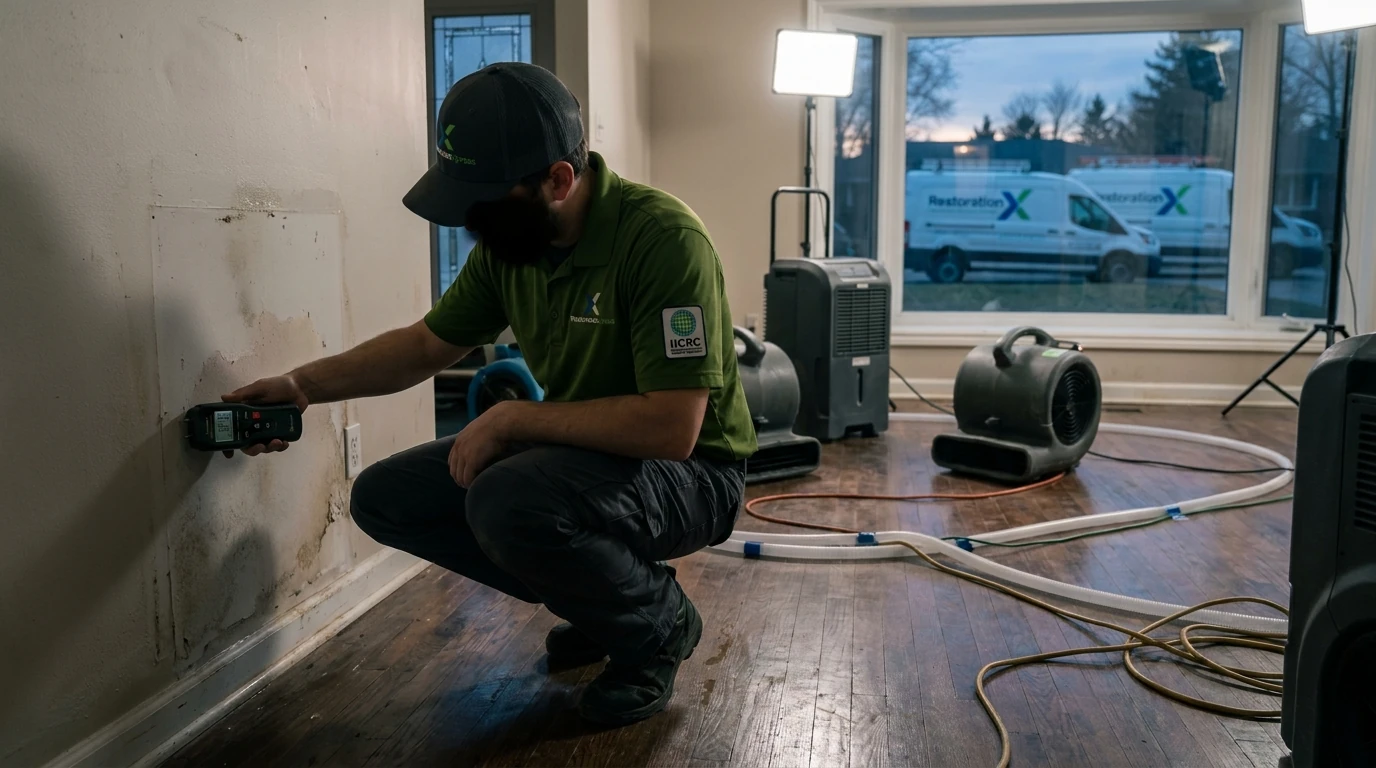
Excellent service on a water damage call starts with measurement, not guessing. A technician uses a moisture meter to map how far water traveled behind walls and under flooring before deciding what needs to come out and what can be dried in place.
From there, the work follows a fairly predictable sequence: standing water gets extracted first, then air movers and dehumidifiers go in to pull moisture out of framing and subfloor. Most reputable crews dry to the IICRC S500 standard, which sets target moisture levels for wood, drywall, and other structural materials rather than relying on how a surface looks or feels. Daily moisture readings track progress and tell the crew when it’s actually safe to close out the job, not just when it looks dry on the surface.
Good service also means being honest about what can be saved. Category 1 water (clean water from a supply line) allows for more salvage than Category 3, also called black water, which typically requires removing porous materials outright. A crew that explains that distinction, instead of just tearing out everything by default, is doing the job right.
Why the Job Isn’t Really Done When the Equipment Leaves
“Going far beyond a simple, one-off interaction” points at something a lot of restoration companies skip: what happens after the drying equipment comes out of the house. A water loss isn’t resolved the moment the air movers shut off; it’s resolved when the homeowner has documentation, a clear final reading, and a plan for anything that still needs repair.
That follow-through usually includes a written scope of the work performed, moisture logs showing the space reached dry standard, and photos that can support an insurance claim. If you’re not sure what your policy actually covers for a water accident like a burst supply line or an appliance failure, our guide on homeowners insurance and water damage breaks down what’s typically covered and what isn’t. Homeowners who’ve just been through the first hours of a leak may also find our first 24 hours checklist useful for next time.
What Does “Resolving the Issues” Actually Involve, Start to Finish?
Resolving a water accident means the property is dry to standard, documented for insurance, and the homeowner knows exactly what happened and why. That’s a different bar than just running fans until things look okay.
A typical sequence looks like this:
- Assessment - moisture mapping and identifying the water category
- Extraction - removing standing water with pumps or truck-mounted extractors
- Drying - air movers and dehumidifiers placed based on the moisture map, not guesswork
- Monitoring - daily readings until materials hit dry standard
- Documentation - photos, moisture logs, and a written scope for the homeowner’s insurance file
Skipping steps, especially monitoring, is how homeowners end up with mold three weeks later even though the floor “felt dry.” If you want to understand how long that full sequence typically runs, see our breakdown of how long water damage restoration actually takes.
If water has gotten into your home recently, the same sequence applies whether the source was a burst pipe, a failed appliance line, or storm intrusion. Getting a moisture assessment scheduled early is what keeps a manageable job from turning into a mold problem.
About RestorationXpress
RestorationXpress serves Davie, FL and nearby Broward County communities, including Fort Lauderdale, Hollywood, Plantation, and Sunrise. The company handles water damage restoration, flood damage restoration, storm damage restoration, fire and smoke damage restoration, and mold remediation. Homeowners dealing with a water accident can request an assessment at (954) 964-6471.
FAQ