
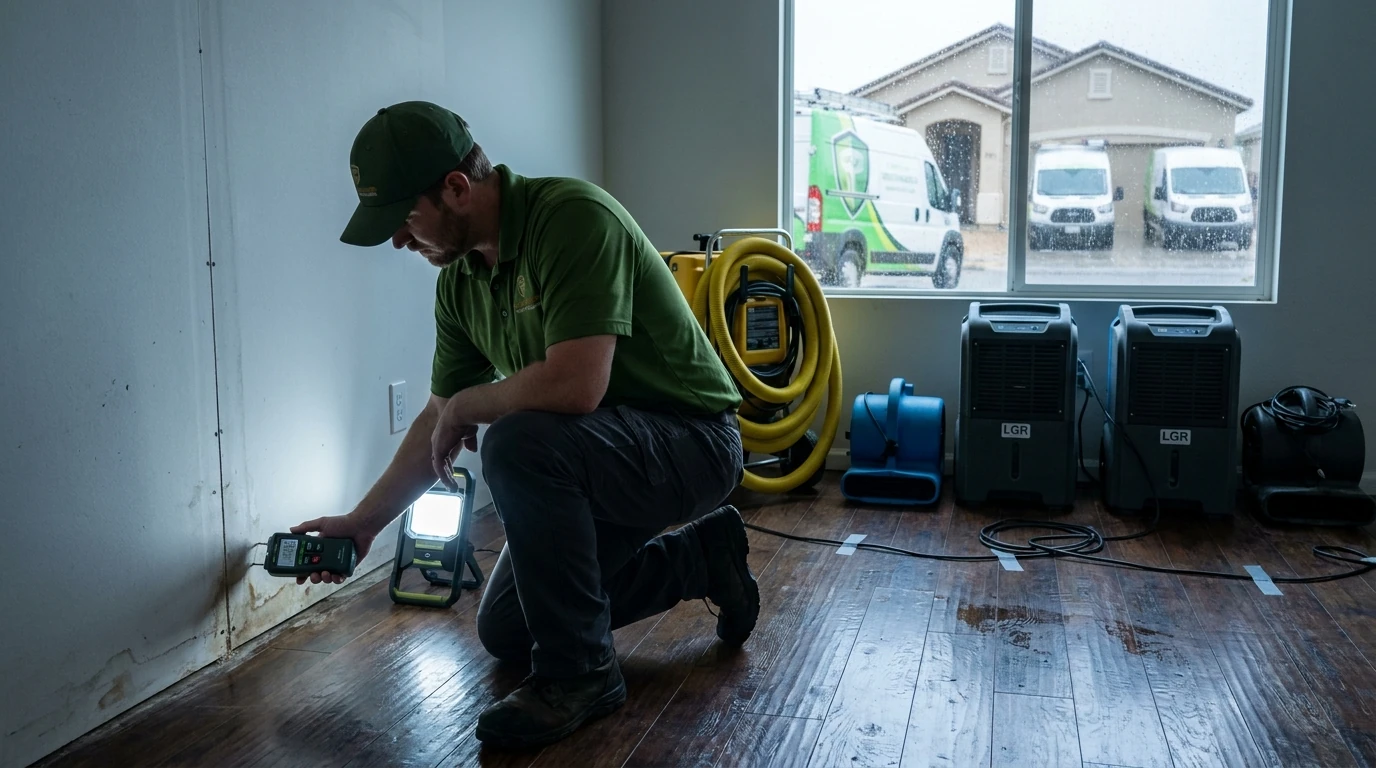
TL;DR: Water damage restoration in Florida typically costs $1,500 to $8,000 for most residential losses. Small, clean-water jobs (a dishwasher line, a supply hose) run $1,200 to $3,500. Larger losses involving contaminated water, finished basements, or multiple rooms can reach $10,000 to $20,000 or more. The single biggest cost driver is how fast you call, every hour standing water sits, it soaks deeper into framing, drywall, and flooring and pushes the job into a higher damage class.
If you’re looking at a wet floor in Davie or anywhere in Broward County right now, you’re probably wondering whether your insurance covers it and what the bill will look like before you commit. This guide gives you realistic Florida-specific numbers, explains what moves the price up or down, and walks through what a professional restoration scope actually includes, so you’re not negotiating blind.
How Much Does Water Damage Restoration Cost in Florida?
In Florida, water damage restoration typically costs $3,500 to $7,500 for a mid-size residential loss, one to three rooms, Category 1 or 2 water, standard drywall and flooring. That range covers extraction, structural drying, antimicrobial treatment, and moisture verification. It does not include reconstruction (replacing drywall, flooring, or cabinets), which is billed separately.
Here’s how costs break down by scenario:
| Scenario | Typical Florida Range |
|---|---|
| Single room, clean water (Cat 1) | $1,200 - $3,500 |
| Two to three rooms, clean water | $3,000 - $6,500 |
| Single room, gray water (Cat 2) | $2,500 - $5,500 |
| Whole-floor or multi-room, gray water | $5,000 - $12,000 |
| Sewage backup or black water (Cat 3) | $4,000 - $20,000+ |
| Storm flood, finished living area | $8,000 - $25,000+ |
| Crawl space or under-slab drying | $2,000 - $6,000 |
These are industry-typical ranges for the South Florida market. Every loss is different, and RestorationXpress provides a written scope before any work begins, no surprise invoices.
What Factors Move the Price Up or Down?
Several variables determine where your job lands in those ranges. Understanding them helps you read any estimate you receive.
Water category. The IICRC S500 standard classifies water losses into three categories. Category 1 (clean water from a supply line or appliance) is the least expensive to remediate. Category 2 (gray water from a washing machine overflow or toilet tank) requires more aggressive cleaning and antimicrobial treatment. Category 3 (black water from sewage, storm flooding, or any water that has sat long enough to become contaminated) requires full PPE, stricter containment, and more material removal, which is why the cost ceiling is so much higher.
Damage class. Beyond category, the IICRC defines four classes of drying difficulty. Class 1 (minimal absorption, hard surfaces) dries quickly. Class 4 (specialty drying, wet concrete, hardwood subfloor, structural lumber) requires low-grain refrigerant (LGR) dehumidifiers and extended drying times, sometimes 5 to 7 days. More drying days means more equipment rental and more technician visits.
Square footage and affected materials. Wet carpet is cheaper to address than wet hardwood or engineered flooring. Wet drywall that has been wet for more than 24 hours typically has to come out. Wet insulation almost always has to come out. Cabinets, tile backer board, and structural framing all add scope. A 200-square-foot laundry room loss is a fundamentally different job than a 1,200-square-foot main floor.
Response time. In South Florida’s humidity, Davie averages around 75% relative humidity year-round, mold can begin colonizing wet materials within 24 to 48 hours. A job that starts within a few hours of the loss is almost always a smaller scope than one that sits over a weekend. The EPA’s mold guidance recommends beginning drying within 24 to 48 hours to prevent secondary mold growth. Waiting costs more.
Reconstruction. Mitigation (extraction, drying, antimicrobial) is the first phase. Reconstruction (replacing drywall, flooring, trim, cabinets, paint) is the second. Many homeowners are surprised when they get two separate invoices. Ask your restoration company upfront whether they handle reconstruction in-house or refer it out, and get a reconstruction estimate before you approve demolition.
What Does Homeowners Insurance Typically Cover?
Most standard homeowners policies in Florida cover sudden, accidental water damage, a burst pipe, a failed appliance supply line, an AC drain pan overflow. They typically do not cover gradual leaks, maintenance failures, or flooding from outside the structure (that requires a separate NFIP flood insurance policy).
For a covered loss, your out-of-pocket cost is your deductible, commonly $1,000 to $2,500 for water losses in Florida, though wind/hurricane deductibles are separate and often much higher. The insurance company pays the remainder of the approved scope.
The documentation that protects your claim includes:
- Moisture readings taken before, during, and after drying (with timestamps and equipment serial numbers)
- Photographs of all affected materials before any demolition
- A written scope of work tied to Xactimate line items (the industry-standard estimating platform)
- A drying log showing daily equipment readings and atmospheric conditions
RestorationXpress handles all of this documentation as part of every job, which matters because adjusters look for exactly these records when evaluating a claim. For more on what policies cover and how to file, see our guide: Does Homeowners Insurance Cover Water Damage?
What Happens During Water Damage Restoration? (Step by Step)
Knowing the phases helps you understand what you’re paying for and where delays can add cost.
-
Emergency extraction. Truck-mounted or portable extractors remove standing water. This is the fastest phase, a crew can extract most residential losses in 1 to 3 hours. The goal is to get water off surfaces before it migrates deeper into materials.
-
Moisture mapping. Technicians use thermal imaging cameras and pin/pinless moisture meters to map exactly where water has traveled behind walls, under flooring, and into structural cavities. This determines the drying zone.
-
Controlled demolition. Wet drywall, insulation, flooring, and other non-salvageable materials are removed. This is not destruction, it’s strategic. Removing wet drywall 12 inches above the waterline lets air movers dry the framing behind it without tearing out an entire wall.
-
Structural drying. LGR dehumidifiers and high-velocity air movers run continuously, typically for 3 to 5 days in Florida conditions. Technicians return daily to log moisture readings and adjust equipment placement. The job is not done when it looks dry, it’s done when moisture readings return to pre-loss baselines.
-
Antimicrobial treatment. EPA-registered antimicrobials are applied to all affected surfaces to inhibit mold growth during and after drying. In Broward County’s climate, this step is non-negotiable.
-
Final moisture verification. A final inspection with moisture meters and sometimes a thermal camera confirms all readings are within acceptable ranges. This documentation goes into your claim file.
-
Reconstruction. Once the structure is dry and verified, reconstruction begins, drywall, flooring, paint, trim, and any affected fixtures. This phase is scheduled separately and its timeline depends on material availability and permit requirements.
For a deeper look at timing, see How Long Does Water Damage Restoration Actually Take?
What Should You Do Right Now?
If you’re dealing with an active loss in Davie, Pine Island Ridge, Forest Ridge, or anywhere in Broward County, the single most important thing you can do is stop the water source and call a restoration company before you call your insurance company. Mitigation has to start first, your insurer will want to see that you took reasonable steps to prevent further damage.
Document everything with your phone before anyone touches anything: wide shots of each room, close-ups of the source, and any visible water lines on walls or flooring. That documentation is the foundation of your claim.
Then get a written scope before approving any work. A legitimate restoration company will provide one. If someone shows up and asks you to sign a blank authorization or a document without line-item pricing, that is a red flag.
RestorationXpress serves Davie and surrounding Broward County communities. Call (954) 964-6471 to schedule a moisture assessment and get a written scope for your loss.
About RestorationXpress
RestorationXpress is a restoration company based in Davie, FL (33314), serving Broward County homeowners and property managers across Davie, Fort Lauderdale, Hollywood, Plantation, Sunrise, Cooper City, Weston, Pembroke Pines, and Miramar. Their crews handle water damage restoration, flood damage restoration, fire damage restoration, smoke damage restoration, storm damage restoration, and mold remediation. RestorationXpress provides written scopes, full insurance documentation packages, and daily drying logs on every job.