Commercial Restoration in Davie
Commercial restoration in Davie and surrounding areas. Insurance billing accepted. Call (954) 964-6471.
Water or fire damage closing down part of your Davie business? Call now for emergency service at (954) 964-6471. A flooded stockroom, a scorched break room, or a burst supply line in a retail space does not just damage materials, it stops revenue, and every hour the space stays wet or smoke-contaminated is an hour your business isn’t operating normally.
What commercial restoration actually involves
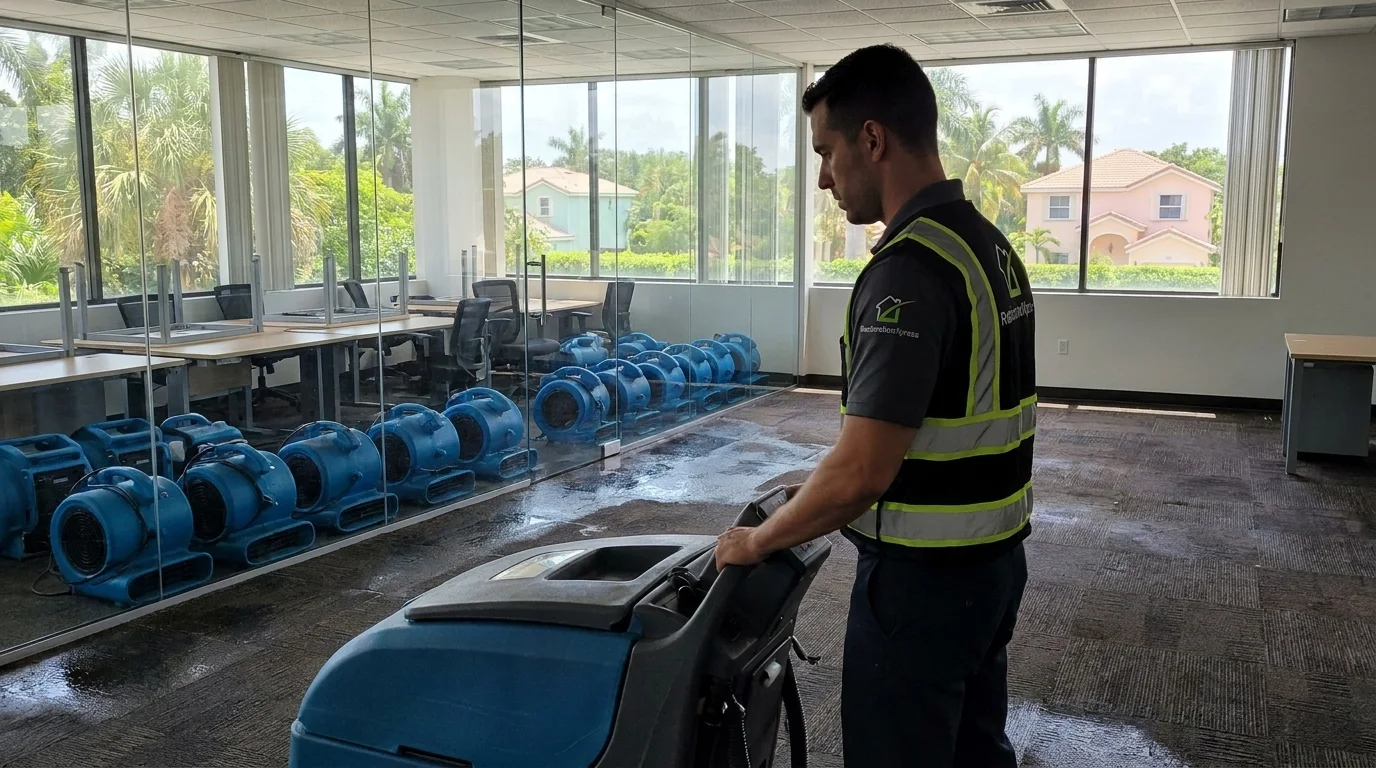
Commercial restoration covers the mitigation and rebuild work needed after water, fire, or storm damage hits an office, retail space, restaurant, warehouse, or multi-tenant property. It’s a different job than residential work in scale and complexity: larger open floor plans, commercial HVAC systems that can spread smoke or moisture across an entire building, drop ceilings that hide water migration, and multiple stakeholders (owner, tenant, property manager, insurance adjuster) who all need to sign off before work moves forward. Equipment needs to match the square footage, often meaning industrial dehumidifiers and air movers rather than the units used in a single-family home, and much of the work has to be scheduled around business hours, lease terms, or customer access so operations can resume as close to normal as possible.
Our process
- Loss assessment and documentation. We walk the affected space with the property manager or owner, photograph the damage, and identify what’s salvageable versus what needs to come out, building the documentation an insurance carrier or business interruption claim will require.
- Containment and phasing. On multi-tenant or multi-room properties, we isolate the affected area with poly barriers and negative air where needed so unaffected parts of the building can stay open.
- Extraction and mitigation. For water losses, that means pulling standing water and setting commercial-grade drying equipment sized to the square footage. For fire or smoke losses, it means removing soot-affected materials and treating surfaces before odor sets into porous finishes.
- Monitoring and code-compliant reconstruction. We track drying progress with moisture meters until materials reach normal levels, then rebuild to match code requirements for commercial occupancy, including fire-rated assemblies and ADA-compliant finishes where applicable.
- Final walkthrough and sign-off. The space is inspected with the owner or property manager before it’s turned back over, with documentation ready for the insurance file.
What separates a good commercial restoration response from a bad one
The most common mistake is undersized equipment. Residential-capacity dehumidifiers and air movers brought into a 10,000 square foot office or retail floor will not dry the space in a reasonable timeframe, which extends downtime and drives up business interruption losses. Another frequent miss is poor coordination between stakeholders: a crew that doesn’t loop in the property manager, tenant, and insurance adjuster early often ends up redoing work or facing disputes over scope later. Adjusters reviewing commercial claims also look closely at pre-loss documentation of equipment, inventory, and fixtures, so a restoration company that skips thorough photo and moisture-log documentation leaves the business owner exposed on the claim. Finally, commercial rebuilds have to meet commercial code, not residential code, covering things like fire-rated partition walls and accessible routes, and missing that during reconstruction can mean failed inspections and delayed reopening.
What does commercial restoration cost?
Commercial restoration costs vary widely depending on square footage, the category of water or fire involved, and how much of the space needs reconstruction versus mitigation only. The ranges below reflect typical industry figures for different scenarios, not a quote, since every loss is different and RestorationXpress provides a written scope of work before any work begins. Homeowners and commercial property insurance will often cover sudden water or fire losses and sometimes business interruption, but coverage depends on the policy and the cause of loss.
| Scenario | Typical range |
|---|---|
| Small office water extraction and drying (under 2,000 sq ft) | $2,000 - $6,000 |
| Retail space smoke and soot cleanup, single area | $3,500 - $9,000 |
| Restaurant kitchen fire damage with equipment loss | $8,000 - $25,000 |
| Multi-tenant building water mitigation, common areas | $5,000 - $15,000 |
| Full commercial reconstruction after structural fire damage | $25,000 - $100,000+ |
Seasonal & regional considerations
South Florida’s wet season and hurricane activity put commercial buildings at ongoing risk for wind-driven rain intrusion and roof leaks, especially on the flat or low-slope roofs common to office parks and strip retail in and around Davie. Ponding water on these roof types can go unnoticed for days before it shows up as a ceiling stain inside the building, by which point insulation and ceiling tile are often already saturated. Year-round humidity also means any water event that isn’t dried quickly has a shorter window before mold becomes a secondary problem on top of the original damage.
Service area
RestorationXpress works with businesses and property managers throughout Davie and the surrounding Broward County area, including Cooper City, Plantation, Weston, Pembroke Pines, and Fort Lauderdale.
If water, fire, or smoke damage is affecting your business, schedule a commercial damage assessment now so we can scope the loss and get your space back open.
Frequently Asked Questions
Does commercial property insurance cover water or fire damage restoration?
Can you restore part of our building while the rest stays open for business?
What documentation do we need for a business interruption claim?
Do you coordinate with property managers when a loss affects multiple tenants?
Why does commercial drying take different equipment than a home would use?
Looking for the best commercial restoration company in Davie?
RestorationXpress provides licensed and insured commercial restoration in Davie, FL and the surrounding area, and has served local property owners since 2011. Customers rate us 4.9 out of 5 stars across 138 Google reviews. We answer calls 24/7 — call (954) 932-5420 for immediate help.
Need Commercial Restoration now?
We respond 24/7 across Davie and surrounding FL cities.