Large Loss and Catastrophic Response in Davie
Large loss and catastrophic response in Davie and surrounding areas. Insurance billing accepted. Call (954) 964-6471.
A single-room water loss and a large loss event are not the same problem at different volumes. They’re different problems. When a loss spans multiple units, multiple floors, or crosses structural and mechanical systems at once, the usual sequence of extract-dry-rebuild breaks down unless someone is coordinating crews, equipment, and documentation across the whole property simultaneously. That’s what large loss and catastrophic response actually means: mobilizing enough resources, fast enough, to keep a six or seven-figure loss from compounding while adjusters, property managers, and ownership groups are still assessing the scope.
What large loss and catastrophic response actually involves
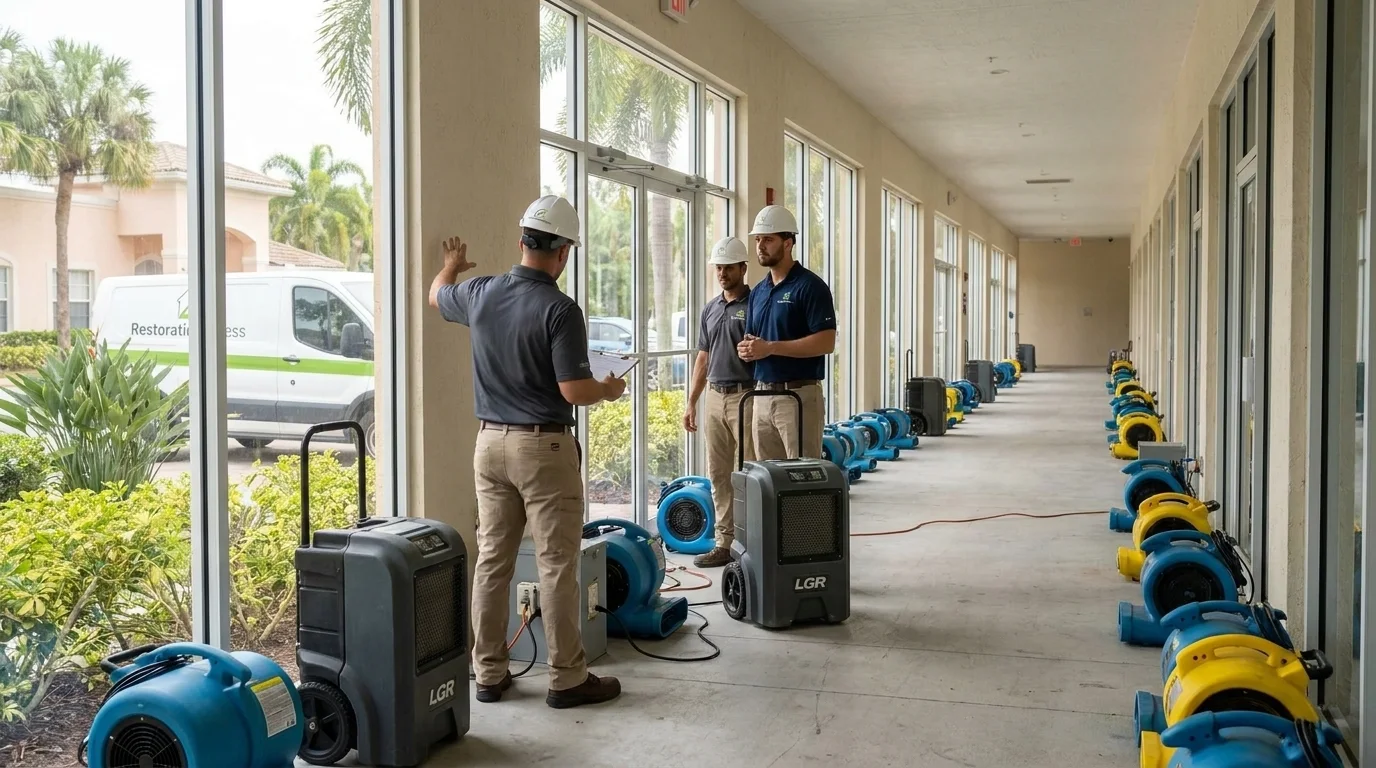
Large loss work typically covers events that exceed a defined dollar threshold (commonly $50,000 and up, though carriers vary) or that affect multiple units, buildings, or tenants at once: a burst main in a mid-rise, a commercial roof failure after a storm, a sprinkler malfunction across several floors of office space, or hurricane damage to a multi-building apartment complex. The work itself is the same core restoration discipline scaled up: extraction, structural drying, demolition of unsalvageable materials, and reconstruction. What changes is the logistics. Crews have to be sequenced so drying equipment doesn’t overload building power, contents from dozens of units need tracked inventory and pack-out, and reporting has to be granular enough that an adjuster or loss consultant can verify square footage, moisture readings, and labor hours line by line.
Our process
- Rapid scope and mobilization. A lead estimator walks the property to establish the extent of damage, affected square footage, and immediate safety hazards, then calls in the crew size and equipment the scale actually requires.
- Triage and stabilization. Structural drying and water extraction start in the highest-risk areas first, typically mechanical rooms, lower floors, and anywhere water is migrating into shared walls or ceilings, to stop secondary damage from spreading while the rest of the site is scoped.
- Phased extraction and demolition. Crews work building-by-building or floor-by-floor rather than all at once, so drying equipment placement and power draw stay manageable and progress can be verified area by area.
- Daily moisture monitoring and reporting. Psychrometric readings and drying logs are tracked per affected unit or zone, which is what large loss adjusters and independent loss consultants expect to see before they’ll approve the next phase of work.
- Reconstruction coordination. Once drying is verified complete, rebuild scopes are packaged by trade and sequenced so the property can return tenants or operations in stages rather than waiting for the entire site to finish at once.
What separates a good large loss response from a bad one
The most common failure on large or catastrophic losses isn’t bad drying technique, it’s bad sequencing and documentation. A contractor who shows up with a standard residential crew and no logistics plan will under-resource the first 48 hours, which is when secondary damage (swelling, mold colonization, electrical hazards) actually gets locked in. Large loss adjusters are looking for daily moisture logs tied to specific rooms or units, photo documentation that matches the line-item estimate, and a clear chain of custody on removed contents, not a lump-sum invoice at the end. Multi-million dollar restoration claims also get bogged down when a single contractor tries to self-perform every trade instead of bringing in qualified subcontractors for specialty work like structural engineering review or large-scale dehumidification, so a response that scales properly usually means a general contractor’s reconstruction crew working alongside a dedicated restoration team from day one, not sequentially.
What does large loss and catastrophic response cost?
Large loss costs are driven by square footage, number of affected units, category of water or contamination, and how much of the structure requires demolition versus drying in place, so the range below reflects typical industry figures for comparable events, not a quote. Every loss is different, and RestorationXpress provides a written scope of work before mobilizing a large-loss-scale crew.
| Scenario | Typical range |
|---|---|
| Single commercial unit, clean water, under 5,000 sq ft | $15,000 - $45,000 |
| Multi-unit residential building, partial flooding | $75,000 - $250,000 |
| Mid-rise commercial property, multiple floors affected | $250,000 - $750,000 |
| Hotel or multifamily complex, storm or hurricane damage | $500,000 - $2,000,000+ |
| Large commercial or industrial facility, category 3 water | $1,000,000 - $5,000,000+ |
Most commercial property policies and master insurance policies on multifamily buildings cover sudden water damage and storm-related losses, though coverage for flood (as distinct from wind-driven rain or burst pipes) often requires a separate policy, which is worth confirming with the carrier early in the claim.
Seasonal & regional considerations
South Florida’s hurricane season runs June through November, and that window is when most catastrophic-scale losses in this region originate: wind-driven rain intrusion through roofing and window systems, storm surge in low-lying areas, and widespread power loss that stalls drying equipment across an entire property at once. Davie’s mix of older concrete block multifamily construction and newer commercial developments means large loss response often has to account for both aging plumbing stacks that fail under pressure and large flat commercial roofs that pond water after a storm, two very different failure modes that can hit the same portfolio of properties in the same week.
Service area
RestorationXpress responds to large loss and catastrophic events based in Davie, FL and across the surrounding Broward County area, including Fort Lauderdale, Plantation, Sunrise, Cooper City, and Pembroke Pines, where multifamily and commercial properties face similar storm exposure and aging infrastructure.
If a property you manage or own is facing a loss that spans multiple units, floors, or buildings, call (954) 964-6471 to start large loss and catastrophic response mobilization and get a written scope before crews arrive.
Frequently Asked Questions
What actually qualifies as a "large loss" versus a standard restoration claim?
Does insurance cover large loss and catastrophic restoration?
How do large loss adjusters get involved in a claim like this?
How is work sequenced across a multi-building or multi-unit property?
What records should a property owner keep while a catastrophic claim is being processed?
Looking for the best large loss and catastrophic response company in Davie?
RestorationXpress provides licensed and insured large loss and catastrophic response in Davie, FL and the surrounding area, and has served local property owners since 2011. Customers rate us 4.9 out of 5 stars across 137 Google reviews. We answer calls 24/7 — call (954) 932-5420 for immediate help.
Need Large Loss and Catastrophic Response now?
We respond 24/7 across Davie and surrounding FL cities.