
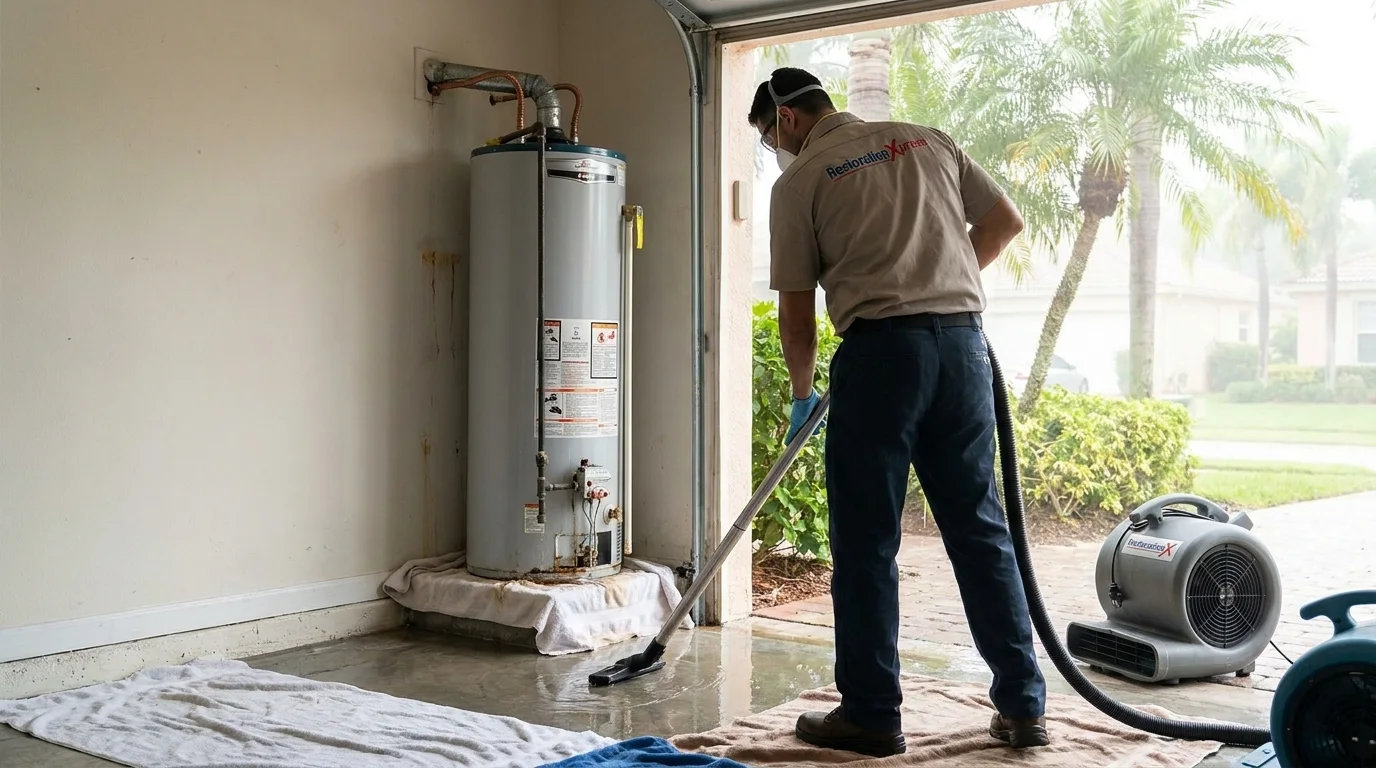
Emergency Water Heater Flood Cleanup in Davie
Emergency water heater flood cleanup in Davie and surrounding areas. Insurance billing accepted. Call (954) 964-6471.
Water heater leaking or burst in your Davie home? Call now for emergency service before the water spreads into flooring, drywall, and the subfloor beneath your utility closet or garage.
A failed water heater rarely announces itself with a dramatic flood. More often it’s a slow weep from a corroded tank seam, a failed pressure relief valve, or a cracked drain fitting that soaks into carpet pad and particleboard cabinets for hours before anyone notices the smell or the soft spot underfoot. By the time you see standing water, the tank has usually been releasing gallons steadily, and that water has found its way under baseboards, behind drywall, and into any adjoining room with a lower slab elevation.
What water heater flood cleanup actually involves
Water heater failures fall into two categories: a slow leak that’s been going for days or weeks, and a sudden tank rupture that dumps 30 to 80 gallons in minutes. Both require the same core response, but the slow leak usually means more hidden saturation because the water has had time to migrate under tile, behind baseboards, and into wall cavities through capillary action. Cleanup starts with shutting off the water supply and, if the unit is gas-fired, confirming the gas line is secure before any extraction work begins. Crews extract standing water with truck-mounted or portable extractors, pull baseboards and sometimes lower drywall to check for saturation inside the wall cavity, and set air movers and dehumidifiers to bring the space back to a normal moisture range. Depending on how long the leak ran before discovery, drying typically takes three to five days, with moisture readings taken daily to confirm the materials are actually drying and not just surface-dry while still wet underneath.
Our process
- Shut off and stabilize. Confirm the water supply is off, check for electrical hazards near the unit, and assess whether the heater itself needs removal or is simply being replaced by your plumber.
- Extract standing water. Remove bulk water from flooring, inside cabinet bases, and from any adjoining rooms the leak reached, starting with the lowest point in the affected area.
- Inspect hidden cavities. Check behind baseboards, under vinyl or laminate flooring, and inside the wall where the heater sits, since tank failures often wick water up into drywall before it’s visible.
- Dry and monitor. Place air movers and dehumidifiers sized to the affected square footage, then track moisture content in flooring and wall materials daily until readings return to normal.
- Document for the claim. Photograph the source, the extent of saturation, and any materials removed, so the cause and scope are clear if you’re filing with your carrier.
What separates a good water heater flood response from a bad one
The most common mistake is treating a water heater leak like a simple mop-up job. Surface water gets wiped up, a fan gets pointed at the floor, and the job’s called done, while the subfloor underneath vinyl plank or the particleboard inside a vanity base stays wet for weeks. That hidden moisture is exactly what turns a one-day cleanup into a mold problem three weeks later. A thorough response checks under flooring where the water pooled longest, not just where it’s visible, and pulls baseboard or drywall when readings show elevated moisture inside the wall rather than assuming it will dry on its own.
Insurance adjusters generally want to see the source of the failure documented, photos of the affected materials before any demolition, and moisture logs showing the drying process rather than a single after-the-fact reading. Operators who skip the daily monitoring step often leave homeowners with a claim that’s hard to support if secondary damage shows up later.
What does water heater flood cleanup cost?
Costs depend heavily on how long the leak ran before discovery and whether water reached flooring, cabinetry, or adjacent rooms. A leak caught within a few hours and limited to a small utility closet costs far less to remediate than a tank rupture that soaked a garage, hallway, and bedroom carpet overnight. Every loss is different, which is why RestorationXpress provides a written scope of work before any cleanup begins. Most homeowners insurance policies cover sudden water heater failures as a covered peril, though gradual leaks caused by long-term neglect are sometimes excluded, so it’s worth checking your specific policy language.
| Scenario | Typical range |
|---|---|
| Small leak, contained to utility closet | $400 - $1,200 |
| Leak affecting adjacent flooring (tile or laminate) | $1,200 - $3,000 |
| Tank rupture with carpet and pad saturation | $2,000 - $4,500 |
| Water reached drywall or cabinetry | $3,000 - $6,500 |
| Multi-room spread with subfloor drying required | $5,000 - $10,000+ |
Seasonal & regional considerations
South Florida’s humidity means wet materials don’t dry on their own the way they might in a drier climate. Even a modest water heater leak can leave enough ambient moisture in a closet or garage to support mold growth within 24 to 48 hours if it isn’t actively dried, not just mopped up. Many Davie homes, especially those built from the 1980s through 2000s, have water heaters installed in garages or interior closets with particleboard or MDF shelving nearby, both of which absorb water quickly and are often the first materials to show damage.
Service area
RestorationXpress responds to water heater flood cleanup calls throughout Davie and nearby communities including Cooper City, Plantation, Pembroke Pines, and Sunrise.
If your water heater is leaking, burst, or you’ve found standing water around the tank, call RestorationXpress now to schedule your moisture assessment before the damage spreads further into your home.
Frequently Asked Questions
Does homeowners insurance cover water heater flood damage?
How do I know if my water heater leak has damaged the subfloor?
What's the difference between cleaning up a slow leak versus a tank rupture?
Can I keep using my water heater while cleanup is happening?
How long does drying take after a water heater leak?
Looking for the best water heater flood cleanup company in Davie?
RestorationXpress provides licensed and insured water heater flood cleanup in Davie, FL and the surrounding area, and has served local property owners since 2011. Customers rate us 4.9 out of 5 stars across 137 Google reviews. We answer calls 24/7 — call (954) 932-5420 for immediate help.
Need Water Heater Flood Cleanup now?
We respond 24/7 across Davie and surrounding FL cities.