
TL;DR: If your AC is leaking and you see a stained ceiling, soaked drywall, or water pooling near a closet air handler, call a water damage restoration company first to extract water and start drying before anything else. Call an HVAC technician separately to clear the clogged drain line or fix the pan that caused the leak. In Davie’s humidity, wet drywall and insulation can start growing mold within 24 to 48 hours, so getting the structure dry matters as much as fixing the AC.
Maybe you walked into a hallway near Pine Island Ridge and noticed a brown ring spreading across the ceiling under the closet where your air handler lives. Or you’re in a Shenandoah townhome and water is dripping steadily from a supply vent. Either way, your first question isn’t “what’s wrong with my AC,” it’s “who do I actually call right now.” Here’s the short version, then the reasoning behind it.
Who do I call first for AC leak water damage in Davie?
Call a water damage restoration company first if drywall, ceiling material, insulation, carpet, or baseboards are already wet, then schedule an HVAC technician separately to repair the leak’s source. For AC-related water damage in Davie, call RestorationXpress at (954) 932-5420.
The reason for the split is simple: an HVAC tech can clear a clogged condensate line or swap a cracked drain pan, but that doesn’t dry out a soaked ceiling cavity or stop mold from colonizing wet insulation. A restoration crew handles extraction, drying, and any ceiling or drywall repair, but doesn’t touch the refrigerant lines or the drain system causing the leak. Most Davie homeowners end up needing both calls, usually on the same day.
If the leak is still active and you can safely reach the breaker, shut power to the air handler so it stops pumping condensate into the ceiling or closet while you make your calls.
HVAC tech or restoration company: how do I know which one I need?
You need both when the leak has already soaked building materials; you only need an HVAC tech if you caught it early and nothing beyond the drain pan got wet. A quick way to sort it:
- Call the HVAC tech alone if you caught a small drip immediately, the pan is wet but the ceiling, closet floor, and surrounding drywall are dry.
- Call a restoration company if there’s a ceiling stain, sagging drywall, a musty smell, water tracking down an interior wall, or standing water near a closet air handler.
- Call both if the leak has been running for more than a few hours, you found it from a stain rather than catching it in progress, or the unit is in an attic above a finished ceiling, since attic leaks often travel before they show up as a stain below.
Attic-mounted air handlers are common in older Davie ranch homes, and a slow drain-line clog up there can soak insulation and drywall for days before a stain appears on the ceiling below. By the time you see it, the damage is usually bigger than the visible spot.
What happens when a restoration crew responds to an AC leak?
A restoration crew starts by finding exactly how far the water traveled, not just where it’s visible. Expect this sequence:
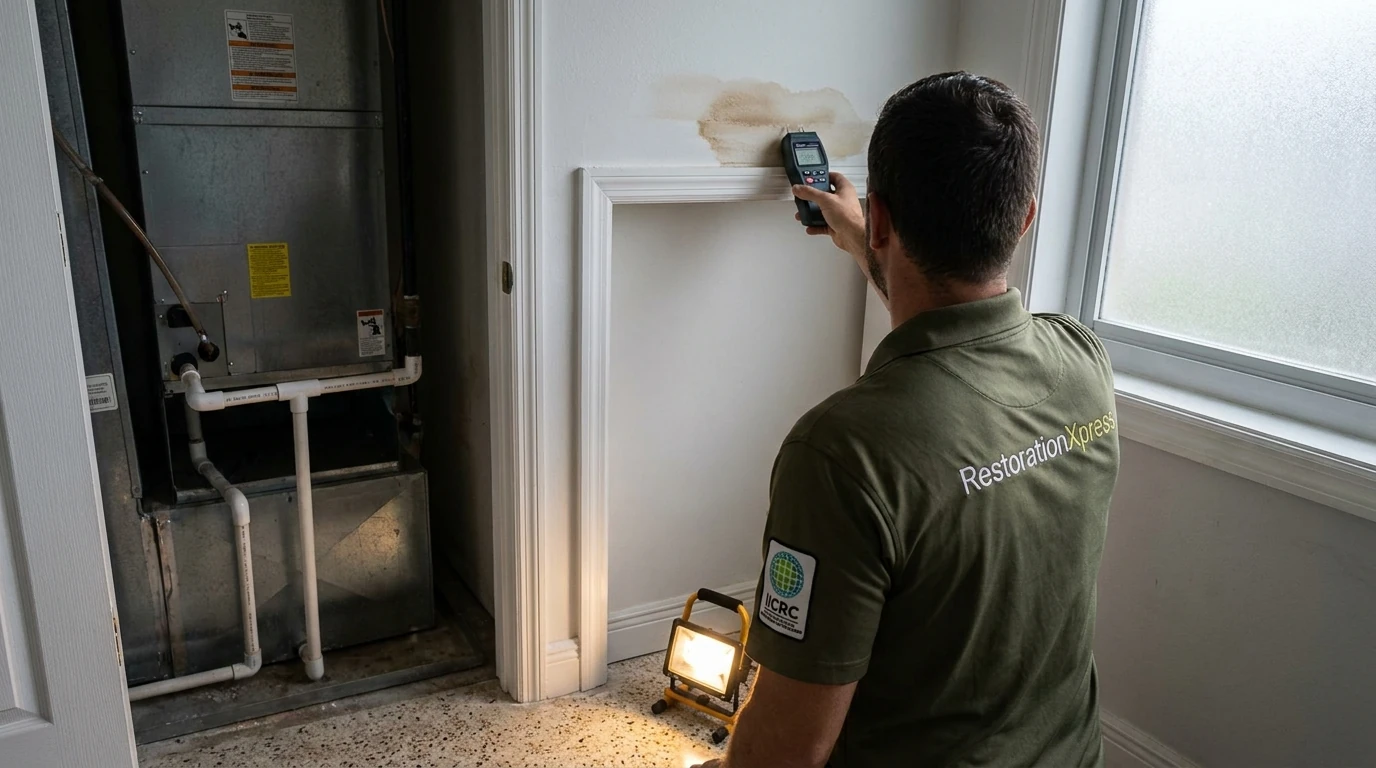
- Moisture mapping. A technician uses a moisture meter and often a thermal camera to trace water behind drywall and above the ceiling, since AC leaks frequently spread sideways along joists before dripping through.
- Extraction. Standing water in the pan area, closet floor, or carpet gets pulled out with extraction equipment.
- Controlled demolition, if needed. Saturated drywall or insulation that won’t dry in place gets cut out, usually in a clean rectangle rather than the whole ceiling.
- Drying equipment setup. Air movers and a dehumidifier get placed to bring the area back to a dry standard, with daily moisture readings to confirm progress.
- Documentation. Photos and moisture logs get recorded for your insurance file, whether or not the claim ends up covered.
Have the leak’s approximate start time, which room and vent it’s near, and whether it’s an attic unit or a closet unit ready when you call. That alone speeds up the first visit.
Because this is clean condensate water when it first appears, drying follows the same standards used for any clean-water loss, per the ANSI/IICRC S500 standard. The faster it’s addressed, the less likely porous materials need to be removed instead of dried.
Why do AC leaks cause so much damage in Davie homes?
AC leaks in Davie cause outsized damage because the units sit directly above living space and Broward County’s humidity accelerates mold growth the moment materials stay wet. Two setups show up constantly here: attic air handlers in older homes near Forest Ridge and Rolling Hills, and closet-mounted units common in newer townhomes and condos closer to Nova Southeastern University.
Both designs route condensate through a small PVC drain line that clogs easily with algae and dust in South Florida’s humidity. When it clogs, water backs up into the overflow pan. If the unit doesn’t have a working float switch, the safety device meant to shut the system off before the pan overflows, water just keeps draining into the ceiling or closet floor until someone notices the stain or the smell.
Because mold can start growing on wet materials within 24 to 48 hours, a condensate leak that runs unnoticed over a long weekend is often already a mold problem by the time it’s found, not just a water problem. That’s a big part of why fast extraction and drying matter even for what looks like a small leak.
Does insurance cover water damage from an AC leak?
Sometimes, but most AC leak claims get denied because insurers classify a slow condensate clog as gradual damage or a maintenance issue rather than a sudden accident. A standard homeowners policy generally covers sudden, accidental water damage, not water that leaked slowly over time from a dirty drain line or an aging unit, as outlined by the Insurance Information Institute.
A sudden event, like a pan cracking outright or a line disconnecting, has a better chance of being covered than a clog that built up gradually. Either way, document the damage with photos and keep the moisture logs from the restoration crew; some claims do get approved, and a denied claim still needs that paperwork if you appeal it. For a broader rundown of how Florida policies typically treat water losses, see who pays for water damage restoration in Davie and how quickly mold develops after a leak.
If the ceiling damage is extensive enough to need drywall replacement or a full ceiling section rebuilt, that repair work typically runs through a ceiling water damage repair scope rather than drying alone. For leaks you can’t locate by sight, a water leak detection visit can confirm the source and extent before any demolition starts.
Don’t wait on a slow drip to decide itself. Call RestorationXpress at (954) 932-5420 to get the structure assessed and drying started, then get your HVAC tech out to fix what caused it.