
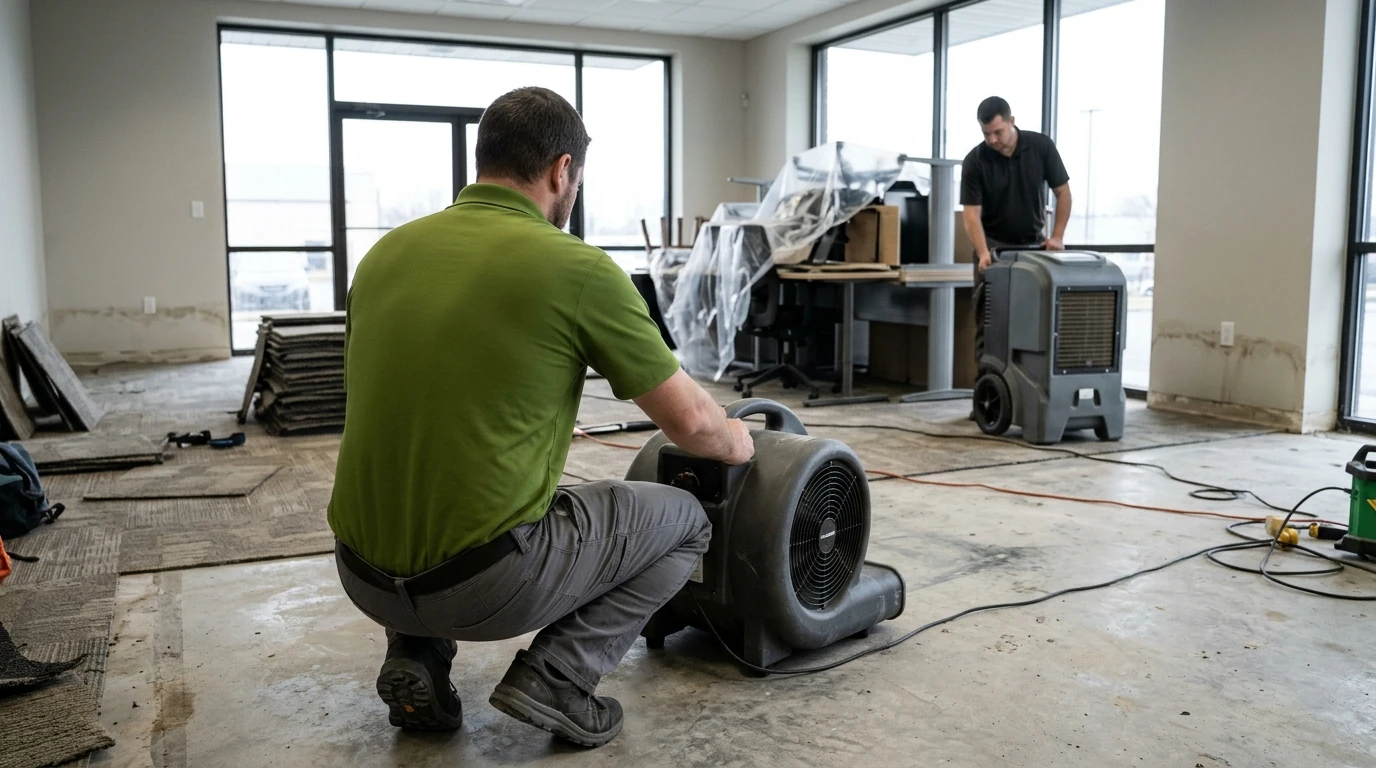
For commercial water damage in Davie, FL, call RestorationXpress at (954) 932-5420. The company answers 24/7, holds Florida certified restoration license #1057, and carries a 4.9-star Google rating across 141 reviews for mitigation and large-loss cleanup across Broward County. Whether a supply line failed over the weekend in an office park near Nova Southeastern University, a retail storefront is standing in an inch of water, or a warehouse sprinkler head tripped overnight near the industrial stretches by Pine Island Ridge, that call starts the clock on drying before standing water ruins inventory, flooring, and electrical systems.
Who do you call first when water floods your business?
Call a commercial water damage restoration company before you call your insurance agent, your landlord, or a general handyman. A restoration crew can shut down the spread, start extraction, and document the loss the way an insurance adjuster expects to see it, which protects your claim from day one.
Most business owners’ first instinct is to call their property manager or wait for a plumber to “fix the leak” before worrying about the water itself. That delay costs you. Standing water on commercial-grade carpet tile, laminate flooring, or a warehouse concrete slab starts wicking into walls and subfloor within hours, and mold can begin growing on wet materials in 24 to 48 hours. The same first-hour priorities that apply to a home apply here (see what to do in the first 24 hours after water damage), but the stakes are higher when you’re also managing tenants, inventory, or a lease.
Is this a restoration call, a plumber call, or a 911 call?
Call 911 or your utility company first only if there’s an active electrical hazard, a gas smell, or visible structural collapse risk; call a plumber only if water is still actively flowing from a fixture or pipe; call a restoration company for everything after that, including coordinating the plumber.
If a pipe is still spraying or a toilet line is still running, the plumber’s job is to stop the source. Once the source is off, the job becomes mitigation: extracting water, setting up commercial-grade air movers and dehumidifiers, and drying the structure to the IICRC S500 standard before mold or secondary damage sets in. A restoration company can usually dispatch to handle both calls in sequence, or coordinate directly with your plumber so nothing sits wet while you’re on hold with two different companies.
What should you ask before hiring a commercial water damage company?
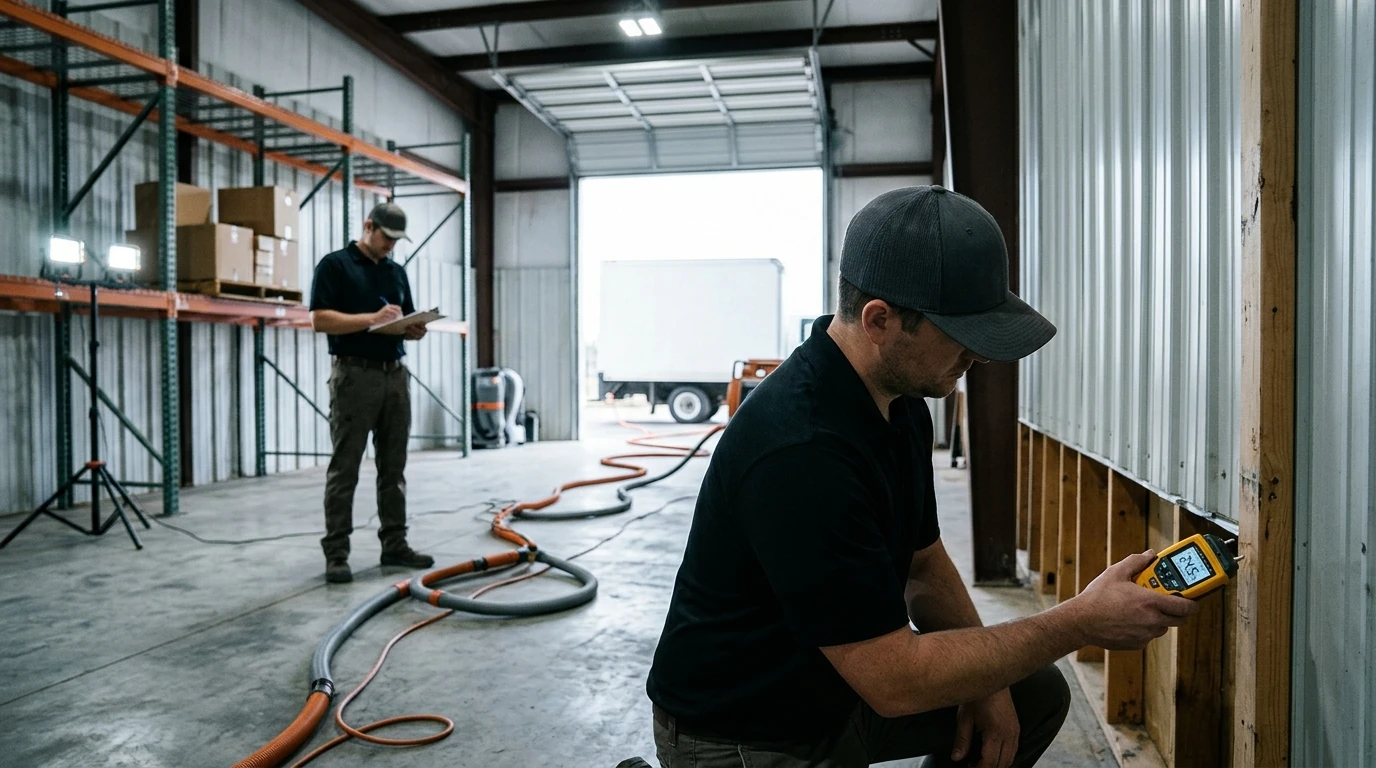
Ask whether the company can handle large-loss work, not just a residential-size job: industrial extraction equipment, commercial dehumidification capacity, immediate dispatch, moisture mapping for your insurance file, and a path from demolition through rebuild under one roof.
A flooded 20,000-square-foot warehouse or a multi-tenant office floor needs truck-mounted extractors and LGR dehumidifiers sized for the square footage, not a handful of residential units. Before you sign anything, ask:
- Can you dispatch immediately, and how many crews do you have available for a loss this size?
- Do you document moisture readings room by room for the insurance adjuster, not just a verbal estimate?
- Do you remove and reinstall ceiling tile, carpet tile, and drywall, or only extract standing water?
- Can the same company carry the job from demo through rebuild, or will I need to hire a separate contractor later?
- Is your license active? Florida contractor licenses can be verified directly through the Florida Department of Business and Professional Regulation.
Does it matter if it’s an office, a retail store, or a warehouse?
Yes. The equipment and priorities shift by property type: offices need server rooms and data cabling protected first, retail stores need inventory and point-of-sale areas dried fast to reopen, and warehouses need large-volume extraction and racking inspected for water intrusion into stored goods.
An office loss usually means carpet tile, drywall, and ceiling grid, plus a hard look at any IT closet or server rack nearby, since electronics and standing water don’t mix. A retail flood threatens merchandise on lower shelving and often means a judgment call on what inventory is salvageable versus a total loss for the claim. A warehouse loss is about volume: more square footage, taller ceilings, and often pallet racking that needs to be moved or inspected before drying equipment goes in. All three need the same thing underneath: fast extraction, aggressive drying, and documentation an adjuster can act on.
Who pays, you or your landlord?
In most commercial leases, the landlord’s property insurance covers the building structure while your business insurance (and often a business interruption or contents policy) covers your equipment, inventory, and lost income, but the exact split depends on your lease language.
Check your lease for a “casualty” or “damage to premises” clause, which usually spells out who repairs what and who pays the deductible. If the water damage came from a building system, a roof leak, or a shared pipe, the landlord’s policy is more likely to apply to structural repairs. If it came from your own equipment or a fixture inside your leased space, your policy may be primary. Either way, document everything from the first call forward. A restoration company that provides detailed moisture mapping and photo documentation gives both insurers what they need to settle faster, and gives you a stronger position if the landlord and your insurer disagree about who’s responsible.
What happens after you make the call?
A crew typically arrives, confirms the water source is controlled, maps moisture levels throughout the affected area with meters, and begins extraction and drying equipment placement the same visit, all documented for the insurance file.
From there, the work moves in phases: extraction of standing water, placement of air movers and dehumidifiers sized to the space, daily moisture monitoring until materials hit a dry standard, then removal of anything that can’t be saved, drywall, flooring, ceiling tile, followed by rebuild. For a large commercial loss this can run anywhere from a few days to several weeks depending on square footage and how much needs to be replaced versus dried in place. Ask for a written scope before work begins; every loss is different, and a documented scope protects you on both the insurance side and the budget side.
If water is actively spreading through your office, store, or warehouse right now, the fastest path to limiting the damage is a direct call: (954) 932-5420. For a side-by-side look at how costs scale by scenario, see commercial water damage restoration cost in Davie, FL. If the loss is at a home instead of a business, the process and the first call look a little different: see who to call for water damage restoration in Davie, FL.
About RestorationXpress
RestorationXpress has served Davie, FL and surrounding Broward County since 2011, holding Florida license #1057 and a 4.9-star Google rating across 141 reviews. The company handles water, flood, storm, fire, and smoke damage restoration for homes and commercial properties, operating a 24/7 line for emergency dispatch across Davie, Fort Lauderdale, Plantation, Sunrise, and Cooper City. This post was prepared with the RestorationXpress team by Jaziel Nahum.